7 Deliverables Every Selection Project Should Produce
2025-12-16
blog/7-deliverables-every-selection-project-should-produce

Most organizations approach a system selection expecting vendor demos, price quotes, and a final recommendation.
In reality, a strong selection project produces a set of foundational deliverables that ensure the chosen system fits the business, the budget, and the long-term roadmap.
7 Deliverables of Credible, Vendor-agnostic Software Selections
1. Current State Technology Architecture
Before evaluating tools, you need a clear picture of what exists today.
This includes systems, integrations, data flows, and manual workarounds.
A well-documented architecture map helps identify technical debt, integration constraints, and opportunities to simplify the landscape.
A complete, accurate view of the existing technology landscape creates the baseline for any future-state design.
A strong architecture assessment includes:
All systems in use (core, ancillary, shadow systems, spreadsheets).
Integrations, data movements, imports/exports, and manual data reconciliation.
Known pain points: instability, outdated software, unsupported tools, and bottlenecks.
System ownership and access patterns.
Areas where the business relies heavily on Excel or manual processes.
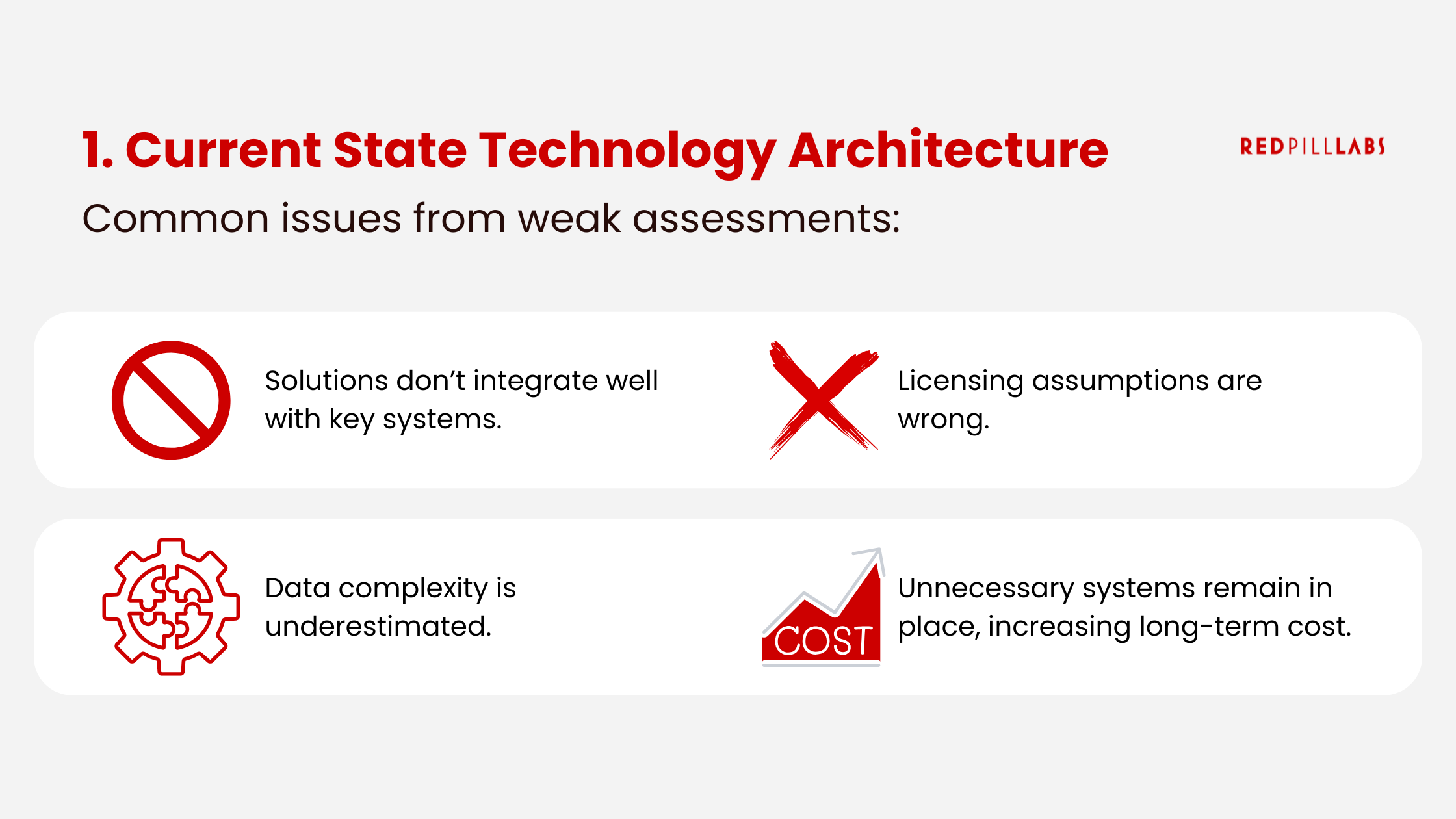
Common issues when this isn’t done well:
Vendors propose solutions that cannot integrate with key systems.
Licensing assumptions are wrong because system volumes and data complexity were underestimated.
Unnecessary systems remain in place, increasing long-term cost.
2. Detailed Process Maps
Every selection depends on a shared understanding of how the business operates.
Mapping current processes, along with pain points and variations, ensures the selection focuses on solving real problems rather than replicating broken workflows.
This documentation also accelerates implementation once a vendor is chosen.
Process mapping must reflect the real way people work—not the idealized version.
Effective process documentation should cover:
Step-by-step workflows for core areas (finance, operations, HR, inventory, etc.).
Pain points, delays, rework loops, and error-prone manual steps.
Variations across branches, departments, or regions.
Data handoffs and approval workflows.
What is currently done manually that should be automated.
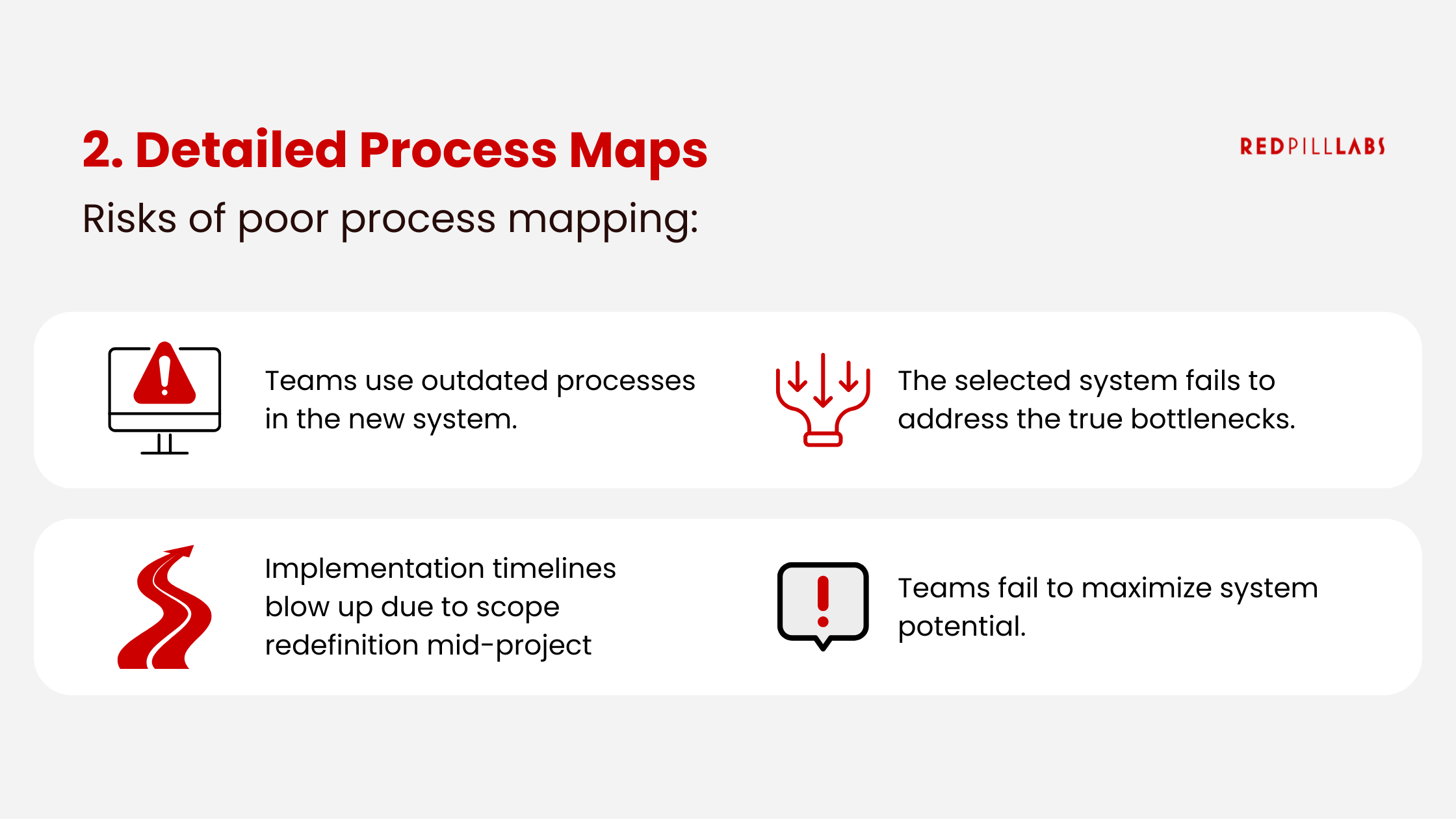
Drawbacks of poor process mapping:
Vendors demonstrate features that don’t match operational reality.
The selected system fails to address the true bottlenecks.
Teams “lift and shift” broken processes into the new system.
Implementation timelines blow up due to scope redefinition mid-project.
3. Prioritized Requirements
A vendor list is only as strong as the requirements behind it.
A structured set of functional and technical requirements, ranked by priority, allows teams to evaluate vendors objectively.
Prioritization forces alignment across leadership and prevents projects from being pushed off course by “wish list” features.
Requirements form the backbone of vendor evaluation—and prioritization ensures alignment.
Strong requirements include:
Functional requirements ranked as must-have, should-have, and nice-to-have.
Technical requirements such as integrations, reporting, security, and scalability.
Performance and volume expectations.
Future-state needs, not just legacy-state replication.
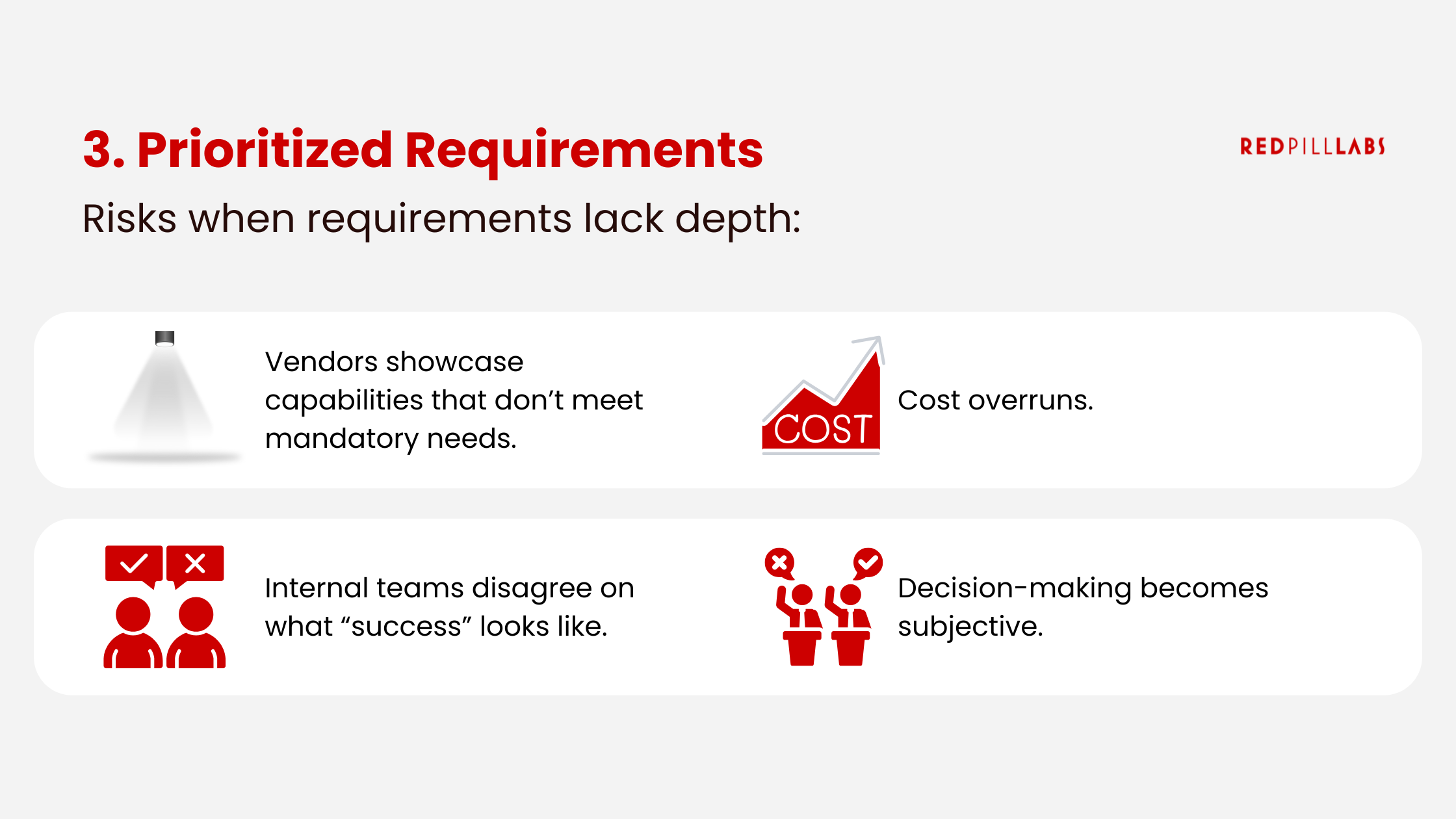
Risks when requirements lack depth or priority:
Vendors oversell high-level capabilities that don't meet detailed needs.
Internal teams disagree on what “success” looks like.
Costs skyrocket because must-have functionality was overlooked early.
Decision-making becomes subjective instead of evidence-based.
4. Budgetary Guidance
Before vendors influence expectations, organizations need an independent view of likely licensing, implementation, and ongoing support costs.
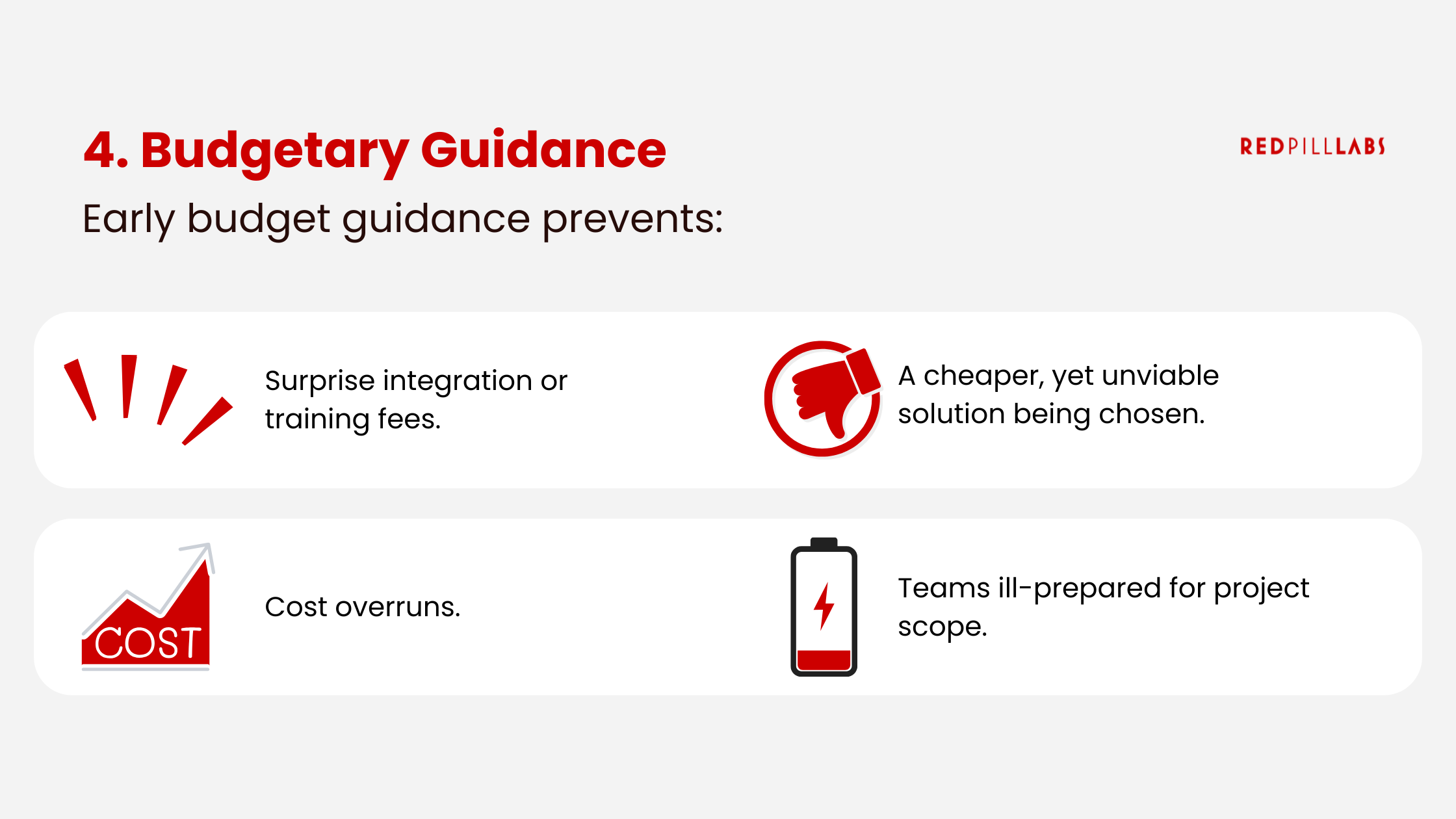
Early budget guidance prevents sticker shock, reduces the risk of selecting an unaffordable solution, and allows teams to secure funding before going to market.
Organizations need independent budget clarity before vendors introduce pricing.
Comprehensive budget guidance includes:
Licensing estimates by user type, region, and module.
Implementation estimates based on complexity and process volumes.
Integration costs, including middleware or custom work.
Internal resource needs and backfill costs.
Ongoing support and subscription escalation expectations.
What goes wrong without proper budgeting:
The “top choice” becomes unaffordable late in the process.
Surprise integration or consulting fees undermine confidence.
Leadership loses trust in the project due to cost overruns.
A cheaper-but-wrong solution is chosen to stay within budget.
5. Vendor Shortlist and Market Scan
A methodical scan of the market should surface a shortlist of two to four vendors that match the business size, industry, complexity, and integration needs.
This avoids the common trap of evaluating vendors simply because they are well-known or recommended by peers.
A structured scan reduces noise and focuses the project on real options.
A strong market scan includes:
Identification of 2–4 vendors aligned to industry, size, and complexity.
Exclusion of systems that are too small, too large, or not industry-relevant.
Early capability checks to avoid wasted demos.
Shortlisting based on requirement fit, not branding or popularity.
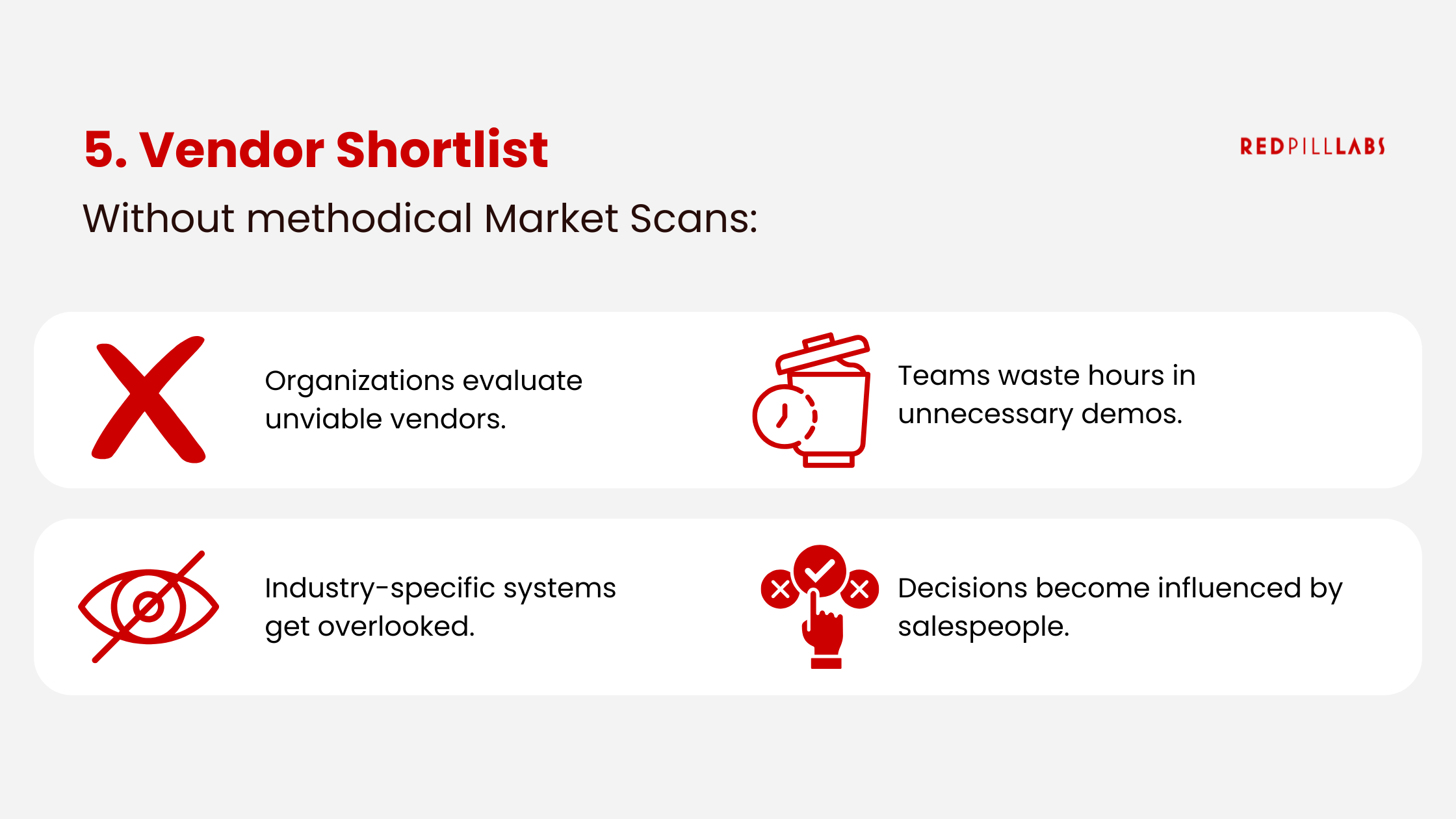
When the market scan is weak:
Organizations evaluate vendors that were never viable to begin with.
Teams waste hours in demos that go nowhere.
Key industry-specific systems are overlooked.
Decisions are influenced by salesmanship instead of fit.
6. Demo Scripts
Demos are one of the most misunderstood parts of the selection process.
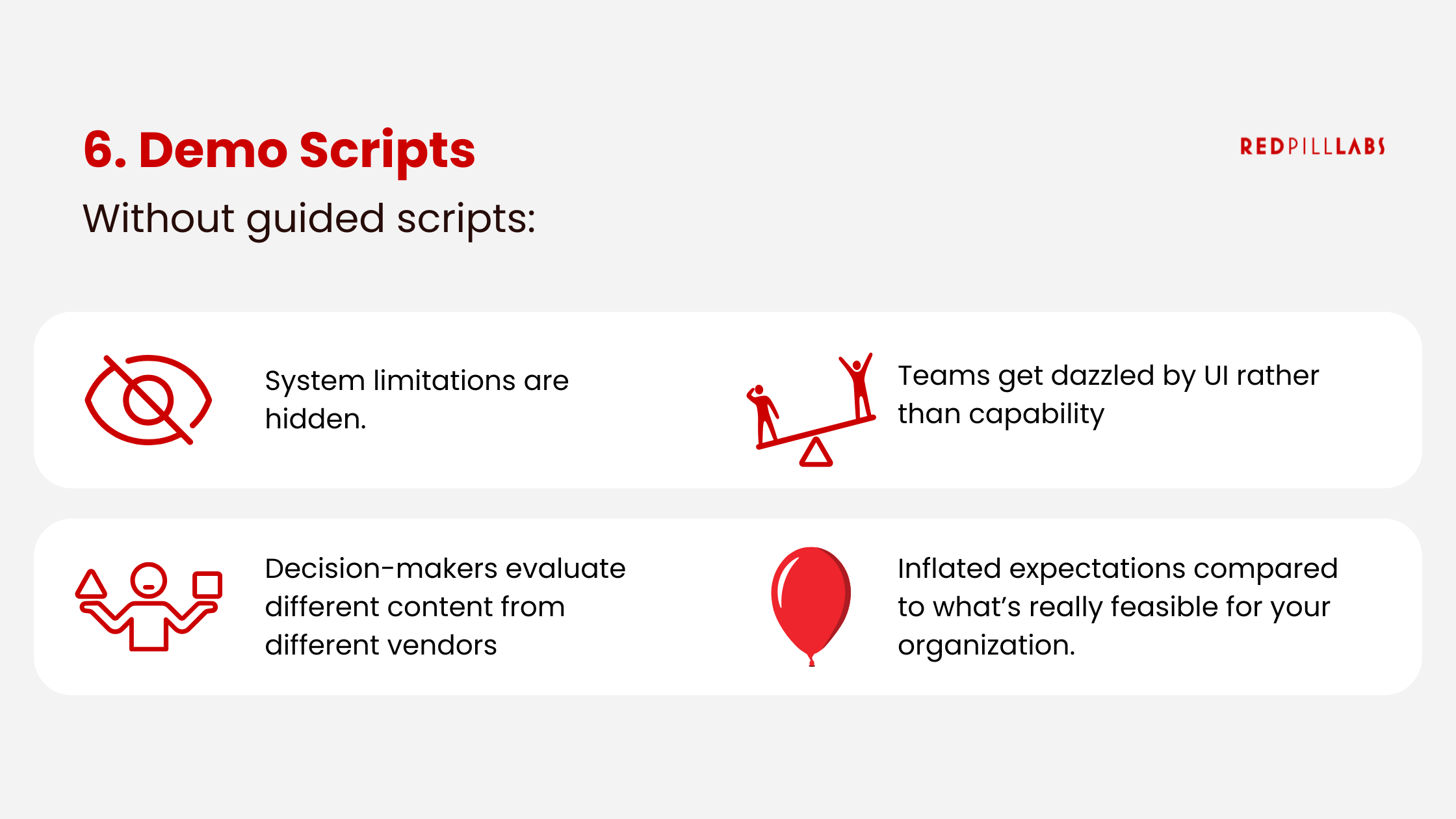
Without guided scripts, vendors default to high-level sales presentations that skip essential workflows.
Demo scripts ensure every vendor shows the same scenarios in the same order, enabling an apples-to-apples comparison.
Demo scripts turn vendor presentations into standardized, comparable evaluations.
A strong script includes:
Real business scenarios that reflect actual workflows.
Required datasets (provided to vendors ahead of time).
Specific tasks vendors must complete live.
Defined scoring sections tied directly to requirements.
A time-boxed structure to avoid sales detours.
Consequences of poorly run demos:
Vendors only show polished features, hiding limitations.
Teams get dazzled by UI rather than capability.
Decision-makers evaluate different content from different vendors.
Unscripted demos inflate expectations and reduce comparability.
7. Scoring Matrix and Final Evaluation
A transparent scoring model allows stakeholders to evaluate vendors against requirements, usability, business fit, and cost.
This creates a defensible selection process that stands up to audit, leadership review, and future changes in organizational memory.
A scoring matrix provides a defensible, transparent framework for selecting the right system.
A strong scoring model includes:
Weighted scoring tied to requirement prioritization.
Separate scoring for usability, reporting, integration fit, and scalability.
TCO (total cost of ownership) comparisons.
Qualitative scoring: vendor reputation, implementation risk, product roadmap.
Consensus-building workshops to review scores and validate alignment.
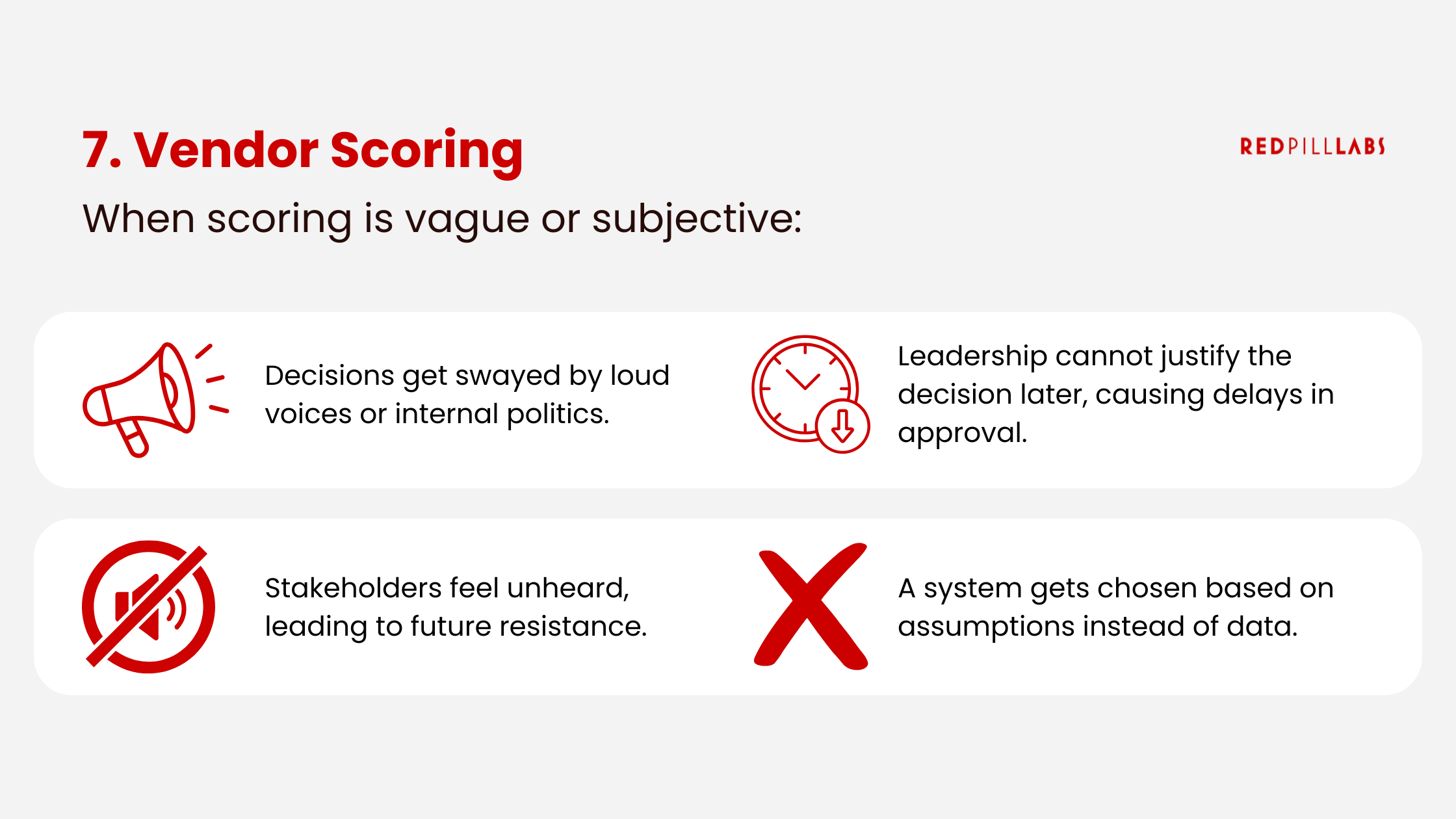
Problems when scoring is vague or subjective:
Decisions get swayed by loud voices or internal politics.
Stakeholders feel unheard, leading to future resistance.
A system gets chosen based on assumptions instead of data.
Leadership cannot justify the decision later, causing delays in approval.