Case Study: Stabilizing an ERP Implementation Across 20+ Entities
blog/case-study-stabilizing-an-erp-implementation-across-20-entities
2026-03-12 | Case Studies

Executive Summary
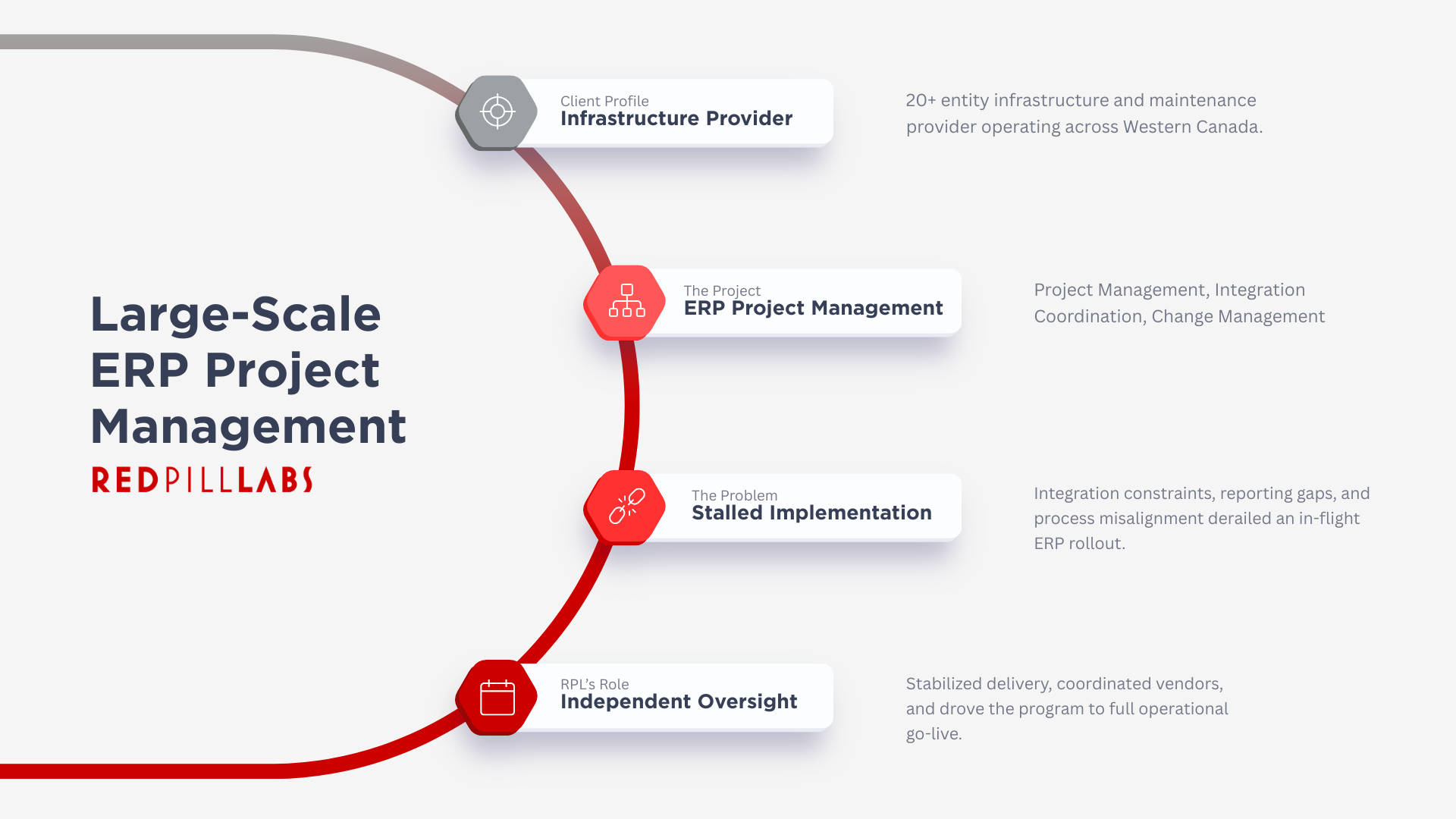
A Canadian infrastructure provider operating across 20+ business entities engaged Red Pill Labs (RPL) after a large ERP implementation encountered delivery challenges related to integration limitations, regulatory reporting requirements, and process alignment.
RPL stabilized the program through independent delivery oversight, structured project management, and targeted system integration, enabling the organization to complete the ERP implementation with full operational coverage.
Key outcomes included:
ERP implementation stabilized across 20+ operating entities
100% of operational activities and processes successfully migrated
Integration of a supporting time tracking solution to meet regulatory reporting requirements
Elimination of manual workarounds and improved workforce readiness through structured change management
Case Snapshot
Client Profile
Canadian infrastructure and maintenance provider operating across western Canada. The organization operates through more than 20 distinct business entities and is subject to significant government compliance and regulatory reporting requirements.
Engagement Type
ERP Implementation Project Management
Integration Coordination
Change Management
HRIS Implementation Project Management
RPL’s Role
Independent delivery advisor providing ERP project management, delivery governance, integration coordination, issue resolution, and change enablement across the organization’s diverse operating entities.
RPL worked directly with executive stakeholders, operational teams, and technology vendors to stabilize delivery, coordinate cross-entity activities, and ensure the ERP implementation remained aligned with regulatory requirements and operational realities.
Situation at Engagement

When RPL was engaged, the ERP program was already underway and key design and implementation activities were in progress. However, delivery momentum had slowed as integration constraints, reporting limitations, and process alignment challenges began to emerge.
Several operational requirements related to government compliance reporting were not fully supported by the initial system design. In addition, assumptions made during earlier planning stages had not fully accounted for the organization’s highly optimized operational processes.
At this stage of the implementation, the organization required independent delivery oversight to stabilize the program, address emerging risks, and ensure the system could support full operational adoption.
The Challenge
The organization delivers a wide range of infrastructure services across more than 20 operating entities, each with distinct operational requirements and regulatory obligations. During the ERP implementation, significant challenges emerged related to system integration and reporting limitations, particularly around report exports required to meet government compliance and regulatory standards.
In addition, one subsidiary required complex, time-based government reporting that the core ERP could not support. This requirement necessitated the evaluation, selection, and integration of a complementary time tracking solution.
As implementation progressed, it became clear that several highly optimized operational processes could not be fully supported by the ERP, despite earlier assumptions that these processes could be accommodated through system configuration. These constraints had not been identified during earlier phases of the program by previous advisors.
While some process refinement is expected in any ERP implementation, late-stage process redesign introduced additional delivery risk, change impact, and adoption complexity. At this stage of the program, broad redesign was not ideal and risked delaying delivery and undermining workforce adoption.
RPL’s Approach
Rather than applying a rigid methodology, RPL focused on stabilizing delivery, resolving system constraints, and ensuring complete operational adoption through targeted, pragmatic intervention.
Program Stabilization & Gap Identification
RPL reviewed existing project plans, solution designs, and integration assumptions to identify gaps between ERP capabilities and operational requirements. This work focused on regulatory reporting needs, integration dependencies, and the ability of the system to support mature, optimized business processes across operating entities.
Where gaps were identified, RPL produced additional process maps, business requirements, and integration documentation to support informed and defensible decision-making.
Project Management & Delivery Oversight
In addition to technical and process advisory support, RPL provided structured project management to stabilize delivery and maintain forward momentum across a complex, multi-entity implementation.
Delivery Planning & Coordination
RPL refined the program delivery plan to reflect the realities of integration constraints, process adjustments, and additional solution components introduced during the project.
This included:
Maintaining the master implementation schedule
Coordinating delivery milestones across ERP configuration, integrations, and complementary systems
Aligning activities across more than 20 operating entities and stakeholder groups
Sequencing testing, data migration, and deployment activities
Given the number of stakeholders involved, active coordination was critical to prevent delays caused by interdependent workstreams.
Schedule Management & Dependency Tracking
The implementation required careful coordination between:
ERP configuration
Integration development
Reporting capabilities
Complementary system implementation
Operational process readiness
RPL maintained a detailed schedule with clearly defined dependencies, ensuring that integration development, process updates, and user readiness activities progressed in alignment with the overall program timeline.
Where risks to schedule emerged, mitigation strategies were identified early to preserve implementation timelines.
Status Reporting & Delivery Transparency
RPL established consistent reporting structures to provide clear visibility into project progress and emerging risks.
Regular reporting included:
Project status updates to leadership
Delivery progress tracking against milestones
Risk and issue registers
Budget monitoring and variance tracking
Integration progress reporting
Change impact tracking
This reporting ensured leadership had clear insight into program health and could make informed decisions as challenges emerged.
Risk & Issue Management
As system constraints and integration challenges surfaced, RPL implemented structured issue tracking and escalation processes.
Activities included:
Maintaining a centralized issue and risk log
Assessing operational and delivery impact
Coordinating resolution across vendors and internal teams
Escalating high-risk items to executive stakeholders when required
This discipline allowed the team to address emerging issues quickly without losing delivery momentum.
Cross-Vendor Coordination
The program required coordination between:
ERP implementation partners
Complementary system vendors
Internal technology teams
Operational stakeholders across business entities
RPL acted as the central coordination point, ensuring that integration requirements, timelines, and responsibilities were clearly defined and aligned across vendors.
Integration & Complementary Solution Enablement
For reporting and operational requirements that could not be reasonably supported by the ERP, RPL supported the introduction of complementary solutions rather than forcing high-risk, late-stage process redesign.
This included the selection and implementation of a time tracking solution to support complex, time-based government reporting for one subsidiary, and its integration into the broader ERP environment.
Targeted Process Alignment
Where system constraints required change, RPL worked closely with stakeholders to pragmatically adjust only those processes necessary to operate within ERP limitations.
The focus remained on minimizing disruption, preserving optimized practices where possible, and avoiding manual workarounds.
Change Management & Adoption Support
As the cumulative impact of delivery delays, system constraints, and revised processes became clear, RPL’s role was expanded to include change management support. This ensured workforce readiness, aligned communications, and structured adoption planning to support a successful transition.
Key Decisions & Trade-Offs
Introduction of complementary systems where ERP functionality was insufficient
Integration over late-stage, high-risk process redesign
Limited, targeted process adjustments constrained only to system limitations
Expansion of change management scope to address increased adoption risk
Outcomes & Value Delivered
Through focused delivery oversight and pragmatic issue resolution, RPL enabled the organization to complete its ERP implementation with full operational coverage across more than 20 operating entities.
Immediate Outcomes
100% of operational activities and business processes migrated, redesigned where required, and fully integrated within the new ERP environment
Elimination of manual workarounds across operational processes
Successful integration of a complementary time tracking solution to meet government regulatory reporting requirements
Improved workforce readiness and adoption through structured change management support
Following completion of the ERP implementation, RPL was subsequently engaged to provide project management support for the organization’s HRIS implementation, which is currently in the final phases of go-live.
Why It Worked
Independent, delivery-focused advisory role
Pragmatic decision-making grounded in operational realities
Strong documentation and integration discipline
Close collaboration across more than 20 operating entities
Willingness to address system constraints directly rather than defer risk
Services Demonstrated
ERP Implementation Project Management
Integration Strategy & Enablement
Business Process Analysis & Documentation
Change Management & Organizational Readiness
HRIS Implementation Project Management
Project Management
Complex technology rollout ahead? Expert project management keeps it on time, on budget, and on target.
RPL's PMO In a Box gives organizations the project management muscle they need for critical technology implementations. From governance frameworks and vendor coordination to risk tracking and go-live execution, we ensure your project doesn't become part of the 60% that fail.