
Case Study: Municipality ERP Selection
blog/case-study-municipality-erp-selection | All Case Studies
2026-02-11

Case Snapshot
Client Profile
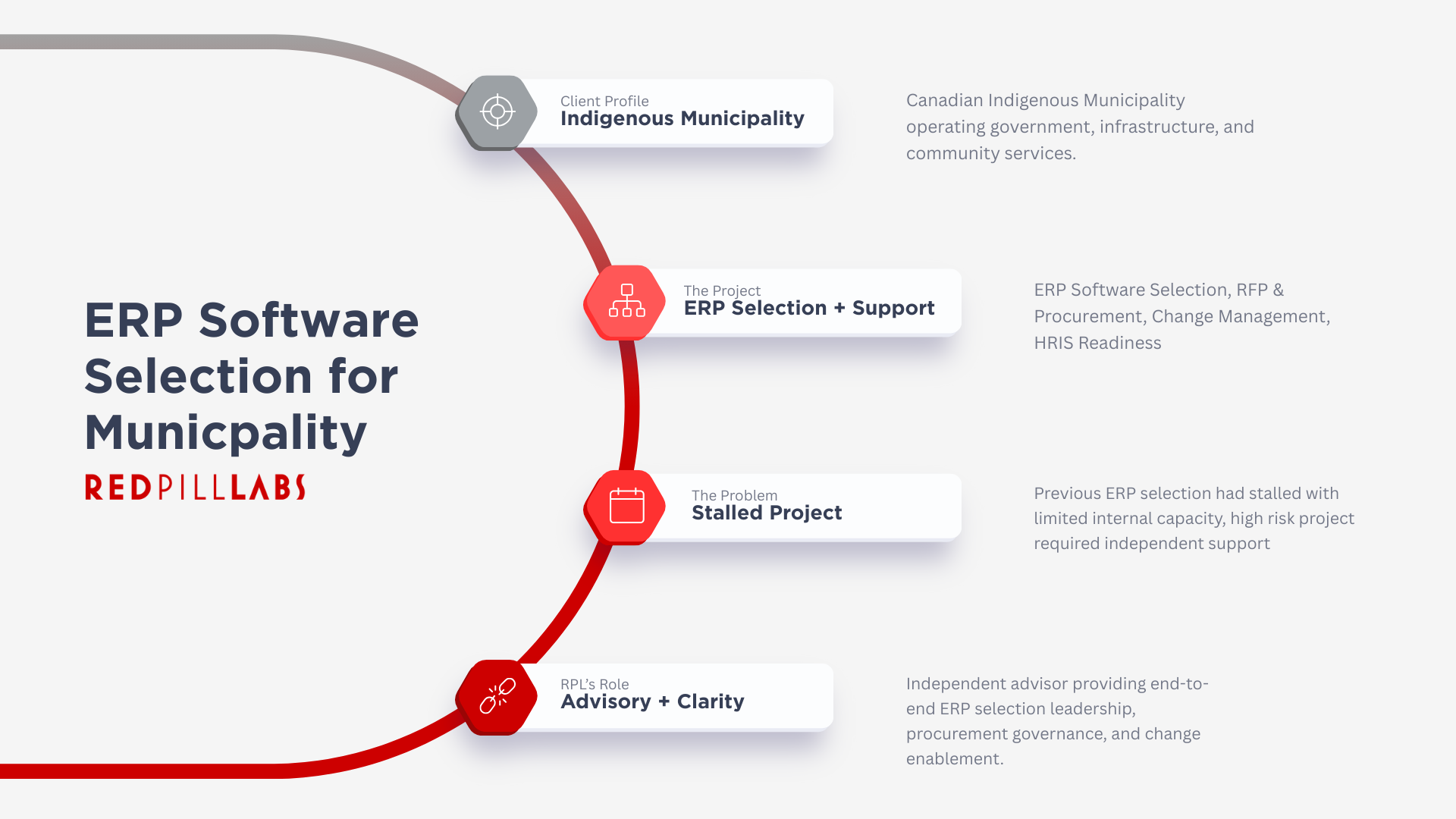
Self-governing Indigenous Nation in Alberta Canada, delivering a wide range of government, community, and utility services in a highly regulated public-sector environment.
Engagement Type
ERP Software Selection, RFP & Procurement Leadership, Change Management, HRIS Readiness
Why RPL Was Engaged
A previously stalled ERP modernization initiative required restart and structure
High operational and compliance risk across diverse service lines
Limited internal capacity to independently manage a complex technology selection
RPL’s Role
Independent advisor providing end-to-end ERP selection leadership, procurement governance, and change enablement.
The Challenge
The client organization delivers a wide portfolio of services, including finance and taxation, bylaws and legal administration, social and economic development, emergency and healthcare services, education, community programs, utilities, and public works. Operating as a self-governing Indigenous Nation, it functions within a regulatory-heavy public-sector environment with accountability to leadership and citizens, while managing the realities of legacy technology and limited internal capacity.
A prior ERP modernization effort had stalled, increasing risk related to system fragmentation, auditability, and long-term scalability. Supporting the initiative required more than selecting new software; it required restoring confidence in the process itself through strong governance, clear requirements, and a transparent, defensible approach aligned with public-sector procurement expectations.
RPL’s Approach
RPL applied a structured but pragmatic approach designed to reduce selection risk, support informed decision-making, and position the organization for long-term success. Rather than treating ERP selection as a purely technical exercise, the engagement emphasized operational realities, governance, and readiness for change.
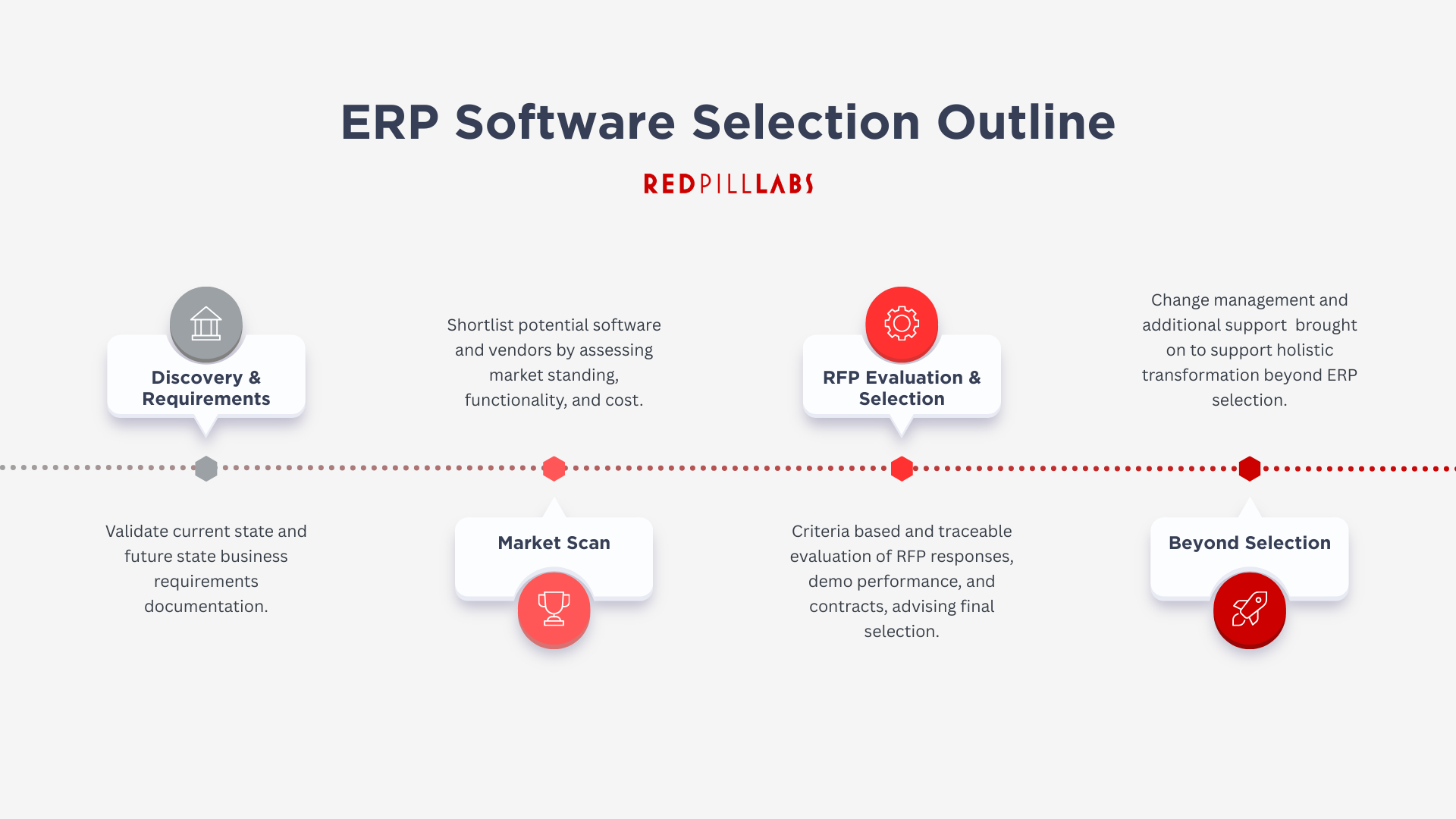
Phase 1: Discovery & Requirements Definition
RPL picked up and validated an existing Business Requirements Document (BRD) developed by a prior consultant, ensuring continuity while addressing gaps and misalignment with the organization’s current operating realities. Working closely with cross-functional stakeholders, RPL reviewed, refined, and extended the documented functional, non-functional, technical, and vendor requirements to ensure they were complete, current, and decision-ready.
This work emphasized the diverse needs of service areas ranging from finance and procurement to asset management, maintenance, and resident-facing services.
Phase 2: Market Scan & Shortlisting
Using the documented requirements as a foundation, RPL conducted a structured market scan of ERP solutions relevant to public-sector and Indigenous government contexts. Solutions were evaluated based on functional fit, deployment options, integration compatibility with both modern and legacy systems, vendor maturity, implementation approach, and cost considerations.
Phase 3: Criteria-Based Selection & RFP Leadership
Building on the market scan, RPL led a criteria-based software selection and managed the end-to-end procurement (RFP) process. This included developing and issuing the RFP, managing vendor communications, coordinating questions and responses, and ensuring a fair and transparent evaluation process. RPL also planned and facilitated vendor demonstrations focused on real-world government scenarios, enabling stakeholders to assess how shortlisted solutions would perform across departments. Vendor proposals and demonstrations were scored against defined criteria, with RPL providing clear comparative analysis and decision support to executive leadership.
Phase 4: Change Management & Readiness Enablement
Following the successful ERP selection, RPL supported readiness activities in preparation for implementation and go-live. This included articulating the case for change, supporting targeted communications, and developing high-level training and readiness plans to prepare users and internal champions.
Separately, RPL was engaged to support change enablement for a newly selected HRIS system. This HRIS-focused work emphasized practical readiness activities such as audience identification, communication planning, training structure, and the development of supporting training materials.
Key Decisions & Trade-Offs
Selection of a scalable ERP platform capable of integrating with both modern and legacy systems
Higher cost more advanced systems (more scalability, higher cost, complexity), Lower cost more targeted systems (less scalability, lower cost, simplicity)
Balancing compliance, governance, and auditability requirements with usability and operational efficiency
Outcomes & Value Delivered
Through a structured, transparent, and defensible approach, RPL helped the organization move forward confidently after a previously stalled modernization effort.
Immediate Outcomes
Restarted and stabilized the ERP modernization initiative through clear scope, governance, and decision-making structure
Delivered a defensible ERP selection aligned with public-sector procurement standards and audit expectations
Provided leadership with clear, criteria-based decision support grounded in documented requirements and objective evaluation
Improved organizational readiness and alignment ahead of implementation
Why It Worked
Independent, vendor-neutral advisory approach
Deep experience with public-sector and regulated environments
Structured methodology combined with pragmatic, delivery-focused execution
Emphasis on transparency, accountability, and long-term scalability rather than short-term technology decisions
Services Demonstrated
ERP Software Selection & Advisory
RFP & Procurement Leadership
Technology Strategy & Roadmapping
Change Management & Organizational Readiness
HRIS Readiness & Enablement


