What Is MCP in AI? A Comprehensive Breakdown of Model Context Protocol
Large language models (LLMs) are prediction engines.
They generate outputs based on the tokens provided to them at runtime, but they do not possess native access to enterprise systems, real-time data, or operational controls.
Any interaction with databases, business applications, or workflows must be explicitly engineered.
Model Context Protocols (MCP) address this limitation by defining a standardized framework that allows AI models to securely access structured context, invoke approved tools, and execute controlled actions across connected systems.
Rather than treating AI as a conversational overlay, MCP positions it as a governed participant within operational infrastructure.
What is Model Context Protocol (MCP)?
Model Context Protocol (MCP) is a standardized communication protocol that enables AI models to:
Access external tools
Retrieve structured data
Interact with applications
Maintain secure, governed context
Execute actions across systems
In simple terms, MCP allows AI models to move beyond text generation and interact with real-world software environments.
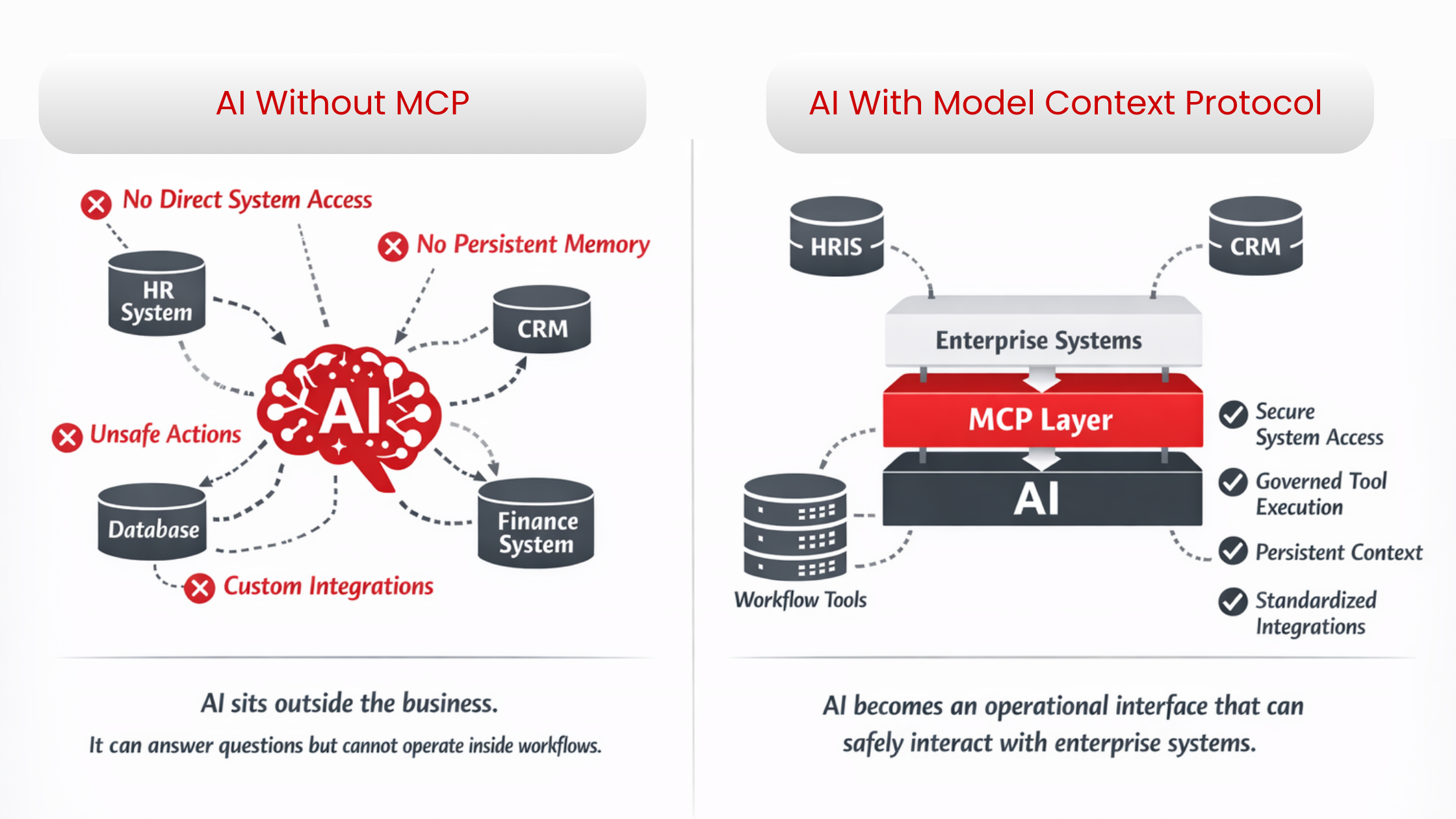
Without MCP, AI models operate in isolation.
With MCP, they can function as intelligent agents inside your existing technology stack.
The Core Problem MCP Solves
Traditional large language models are limited in several ways:
They cannot directly access live systems.
They lack persistent memory across sessions unless engineered separately.
They cannot safely execute business-critical actions without structured controls.
Integrations are often custom-built and fragile.
Organizations quickly discovered that “adding AI” is not the same as embedding AI into operational workflows.
MCP addresses this by creating a standardized method for AI to interact with enterprise systems.
Key Components of Model Context Protocol (MCP)
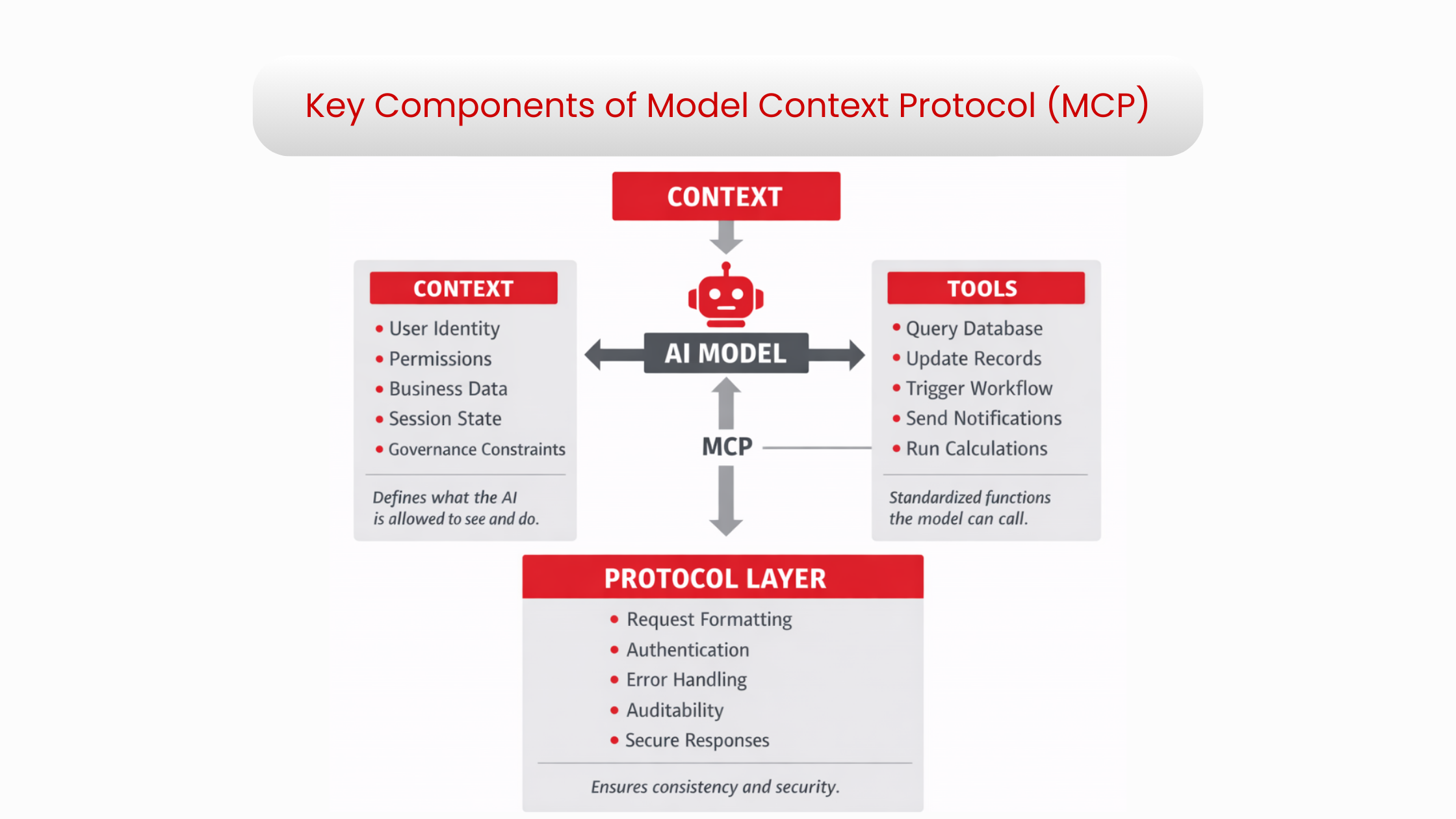
1. Context
The structured data provided to the AI model, including:
User identity
Permissions
Relevant business data
Session state
Governance constraints
Context ensures the AI acts within the correct scope.
At a high level, MCP sits between:
The AI model
The tools and systems it needs to access
The protocol defines how information is passed between them.
2. Tools
Tools are structured functions or system endpoints the model can call. These may include:
Querying a database
Updating a record
Triggering a workflow
Sending a notification
Running calculations
MCP standardizes how these tools are described so the model knows:
What the tool does
What inputs it requires
What outputs it returns
3. Protocol Layer
The protocol layer governs:
How tool requests are formatted
How responses are returned
Authentication
Error handling
Auditability
This layer ensures consistency and security.
4. How MCP Works in Practice
Here is a simplified flow:
A user submits a request.
The AI model determines whether it needs external data or action.
The model calls a tool via MCP.
The tool executes within defined permissions.
The response returns to the model.
The model produces a final answer or completes an action.
The critical difference is that the model does not “guess” or fabricate. It retrieves authoritative data through structured calls.
Why is MCP Important for Enterprise AI
Model Context Protocol provides several key benefits that contribute to making AI more valuable to both organizations and their customers.
Standardization: Instead of building custom integrations for every AI use case, MCP provides a consistent framework.
Security: Permissions are enforced at the protocol level. The AI cannot exceed the authority granted within context.
Governance: Every action can be logged and audited.
Scalability: New tools can be added without redesigning the entire AI architecture.
Reduced Hallucination: When AI retrieves structured data instead of relying solely on training data, accuracy improves.
Limitations of MCP
MCP is powerful but not magic.
Limitations include:
It requires mature system architecture.
Data cleanliness becomes critical.
Misconfigured permissions can create risk.
Tool design must be precise and well-documented.
Governance must evolve alongside automation.
MCP amplifies both strengths and weaknesses in your environment.
Learn about AI Readiness here.
Key Takeaways
Model Context Protocol (MCP) is a standardized framework that enables AI models to securely access tools, data, and workflows.
It transforms AI from a conversational interface into an operational engine.
At its core, MCP provides:
Structured context
Governed tool access
Secure execution
Scalable architecture
As enterprise AI matures, protocols like MCP will define the difference between experimentation and true operational intelligence.