
Dayforce HCM: How to Achieve a Successful Talent Module Implementation
blog/dayforce-hcm-how-to-achieve-a-successful-talent-module-implementation | Dayforce Resources
2026-09-23
Implementing the talent modules within Dayforce can deliver significant value across hiring, performance, learning, compensation, and succession planning.
However, outcomes vary widely depending on how comprehensively the system is configured and how well data flows across modules.
Organizations that underperform typically do not fail because the platform lacks capability.
They fail because modules are implemented in isolation, optimized too narrowly after go-live, or under-supported from a governance perspective.
Below is a breakdown of the most common implementation challenges and what strong configurations typically deliver.
Common Implementation Challenges of Dayforce Talent
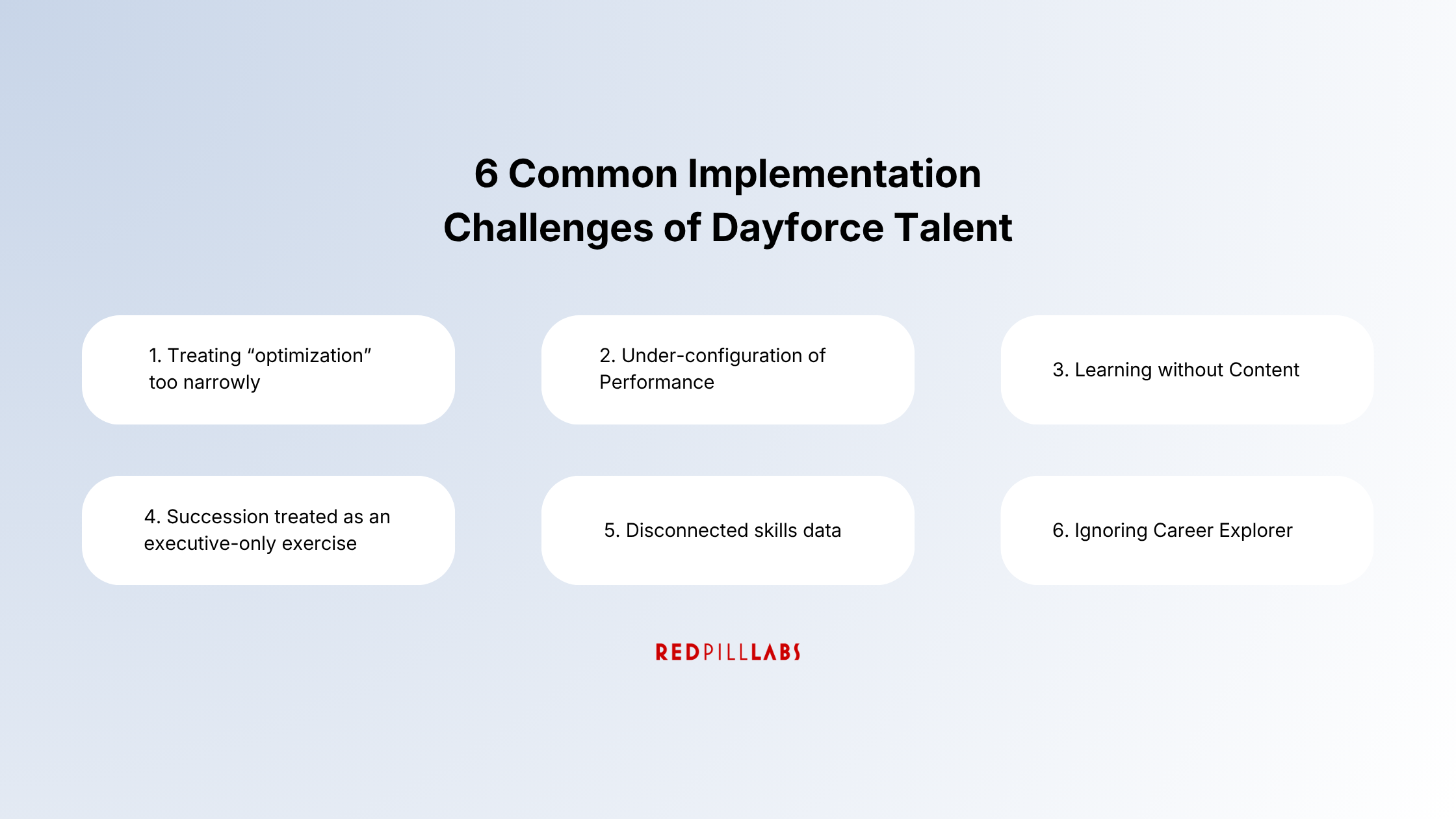
1. Treating “Optimization” Too Narrowly
Post-go-live efforts often focus on incremental fixes to what is already deployed rather than expanding the system footprint.
This limits long-term value.
In practice, optimization should also include evaluating modules that were not initially implemented. Compensation, Content, and Career Explorer are frequently purchased late, even though they deliver the most value when included in the original scope.

2. Under-configuration of Performance
Performance management is often over-engineered during implementation. Complex review forms, excessive fields, and rigid annual cycles tend to reduce participation and manager engagement.
Simpler configurations, with clear goals and more frequent feedback loops, consistently drive higher adoption and better outcomes.

3. Learning without Content
Deploying the Learning module without the Content library significantly limits its value.
Without curated and structured content, organizations typically fall back to compliance training only. This restricts the system from supporting broader capability development, internal mobility, and retention strategies.

4. Succession Treated as an Executive-only Exercise
Succession planning is often restricted to senior leadership roles.
However, within Dayforce, succession capabilities are designed to support talent pools across the organization. Limiting usage to executive roles reduces organizational resilience and leaves mid-level leadership gaps unaddressed.

5. Disconnected Skills Data
Skills data is frequently treated as a one-time setup rather than a continuously maintained dataset.
When skills are not actively governed and connected across modules, AI-driven recommendations become less accurate over time. This weakens matching, development suggestions, and mobility pathways.
Sustaining value requires ongoing ownership and data maintenance.
6. Ignoring Career Explorer
Internal mobility is one of the highest-return talent strategies available, yet Career Explorer is often left unused.
Organizations that do not implement it miss a structured way to connect employees to internal opportunities, reducing retention and increasing external hiring costs.

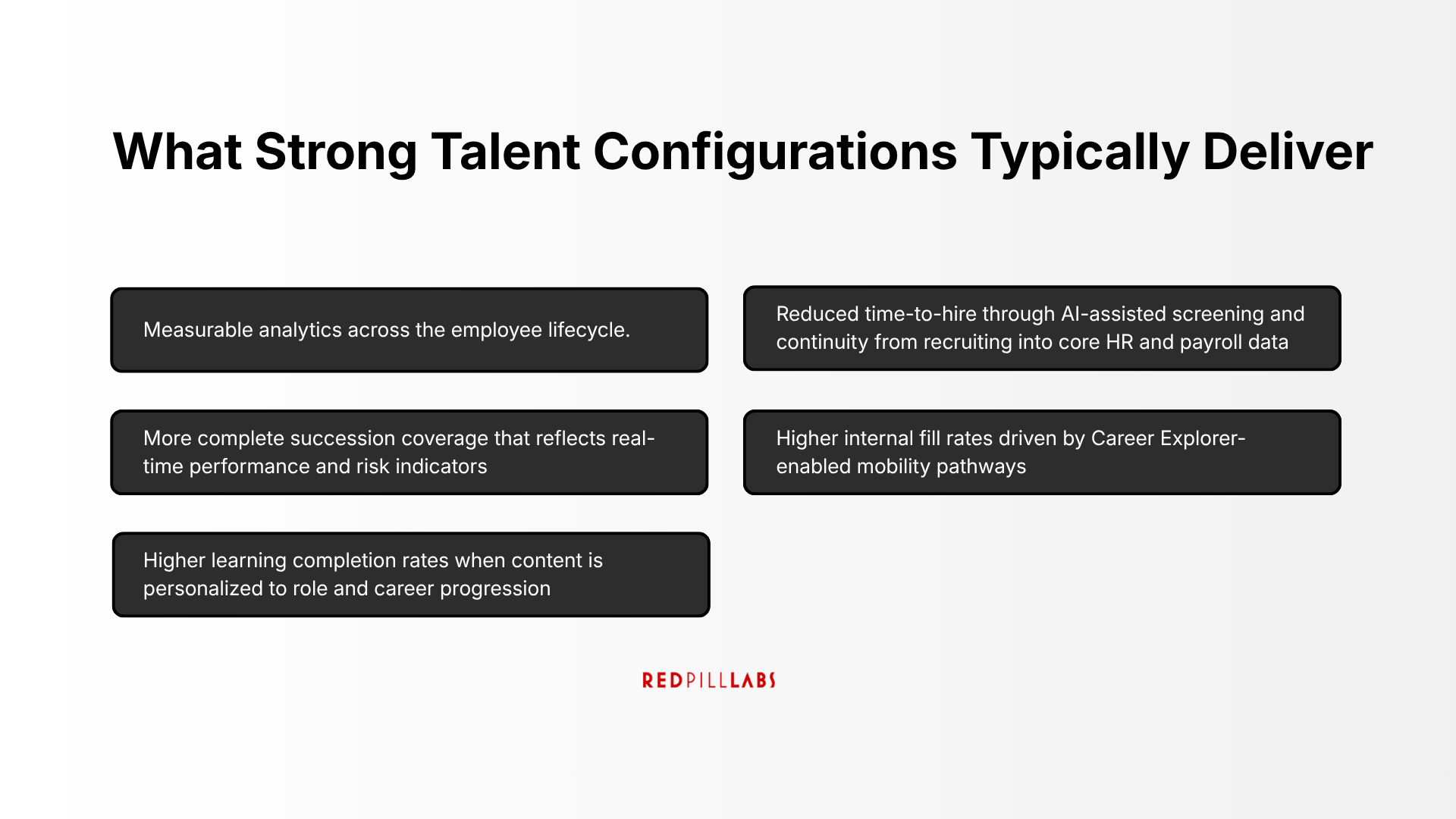
What Strong Talent Configurations Typically Deliver
When the talent suite is fully deployed and properly governed within Dayforce, organizations typically see measurable improvements across the employee lifecycle:
Reduced time-to-hire through AI-assisted screening and continuity from recruiting into core HR and payroll data
Higher internal fill rates driven by Career Explorer-enabled mobility pathways
Improved manager adoption of performance cycles through simplified, continuous feedback models
Faster and more accurate compensation cycles due to native integration with payroll
More complete succession coverage that reflects real-time performance and risk indicators
Higher learning completion rates when content is personalized to role and career progression
Key Takeaway: Value Comes from Connection
The real advantage of Dayforce is not any single module in isolation.
It is the connection between them.
Talent data becomes significantly more powerful when it flows continuously across hiring, performance, learning, compensation, and succession planning.
When those systems operate independently, value is fragmented. When they are integrated, organizations gain a compounding effect across the entire employee lifecycle.
