
AI Readiness Gap: Why Most Organizations Aren’t There Yet
blog/ai-readiness-gap-why-most-organizations-arent-there-yet
2026-04-27

There’s a growing gap in how AI is being built, sold, and actually used.
Vendors are sprinting ahead while many organizations are still figuring out where to start.
That gap is starting to show up in failed implementations, underused features, and a lot of expensive “AI-powered” tools that don’t meaningfully change how work gets done.
The issue is not the technology itself, but how it is implemented and operationalized.
AI Capability Is Outpacing Operational Readiness
Most AI-enabled tools assume a level of operational maturity that is not yet in place for many organizations.
This includes:
Consistent and standardized workflows
Reliable and well-structured data
Clear ownership of processes and decisions
Alignment across systems and teams
In practice, many organizations are still working through fragmented processes, manual workarounds, and inconsistent data structures.
Introducing AI into this environment does not resolve these issues but instead makes them more noticeable.
Read More: A Comprehensive Breakdown of Model Context Protocol
Implementation Challenges Are the Primary Constraint
The effectiveness of AI is highly dependent on the environment it is introduced into.
Recent research indicates that up to 85% of AI projects fail to deliver intended business outcomes¹.
The common causes are not related to model performance or technical capability.
They are tied to implementation challenges such as:
Poor data quality
Unclear process design
Lack of internal alignment
Limited change management
These are operational issues, not technical ones.
Read more: Famous ERP Failures: Lessons Learned
Where AI Delivers Measurable Value
Organizations that are seeing value from AI tend to have a strong operational foundation already in place.
Common characteristics include:
Defined and repeatable workflows
High data accuracy and consistency
Clear governance over systems and processes
Limited reliance on manual interventions
In these environments, AI can enhance existing processes by reducing repetitive tasks, improving visibility, and supporting better decision-making.
Read More: Case Study: How Red Pill Labs Stabilized an ERP Implementation Across 20+ Entities
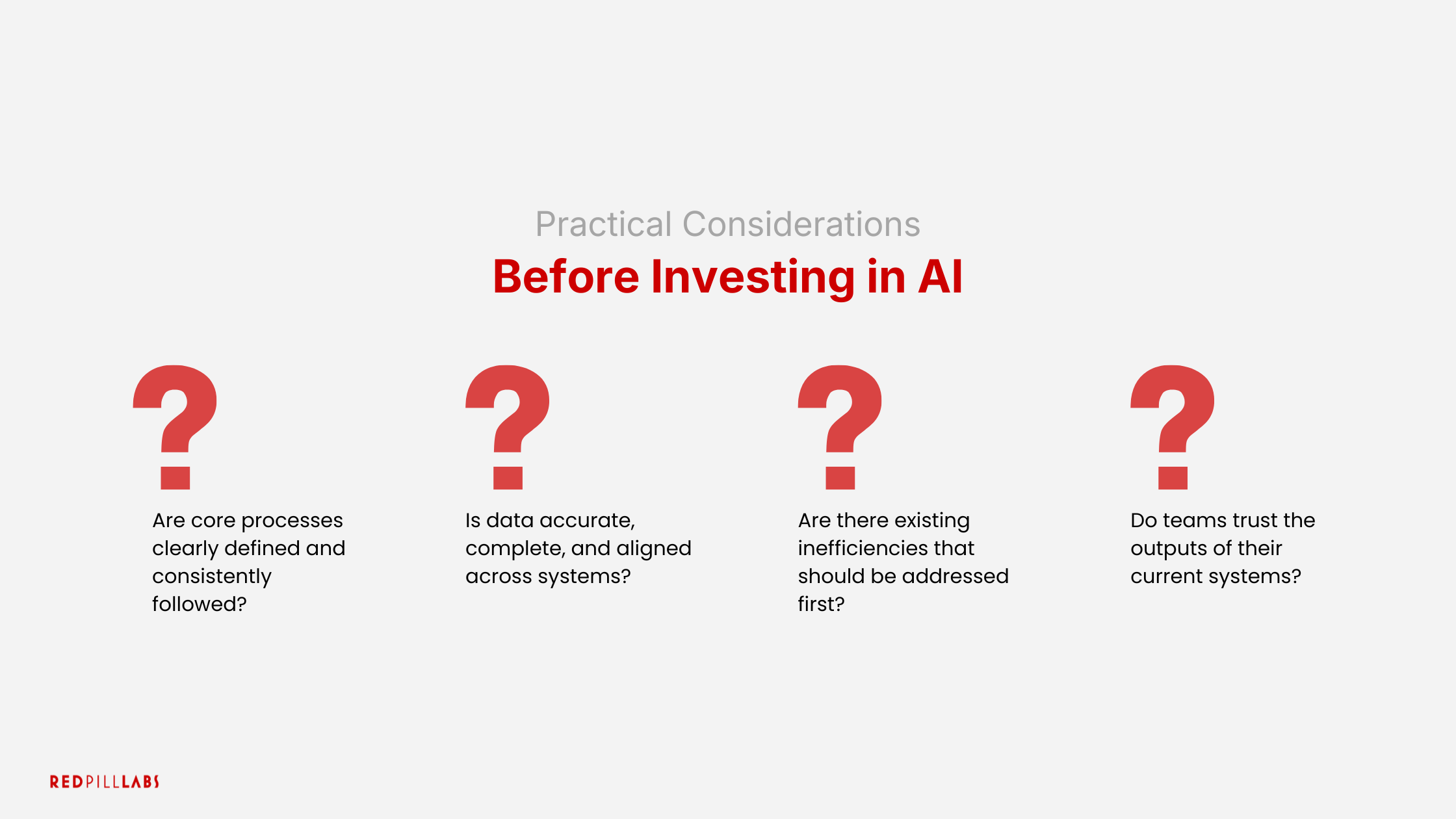
Practical Considerations Before Investing in AI
Before prioritizing AI capabilities, organizations should assess their current state in a few key areas:
Are core processes clearly defined and consistently followed?
Is data accurate, complete, and aligned across systems?
Are there existing inefficiencies that should be addressed first?
Do teams trust the outputs of their current systems?
Addressing these questions upfront typically has a greater impact than introducing new technology.
Key Takeaway
AI’s effectiveness for organizations is dependant on the environment in which it is implemented.
For most organizations, the priority should not be accelerating AI adoption, but strengthening the operational foundation that allows it to deliver value.
More Articles From Red Pill Labs



Sources
¹ Gartner / McKinsey estimates on AI project success rates, 2025–2026
