Top 5 AI Mistakes to Avoid
blog/top-5-ai-mistakes-to-avoid-in-2026
2026-05-28

AI is becoming a core part of how businesses operate.
However, most organizations are still struggling to turn AI adoption into measurable business value.
According to McKinsey’s 2025 State of AI report, 88% of organizations are using AI in at least one business function, but only 39% report meaningful enterprise-level financial impact.
The issue usually is not the technology itself.
It is how companies implement, structure, and manage it. Here are five of the most common AI mistakes businesses make, and how to avoid them.
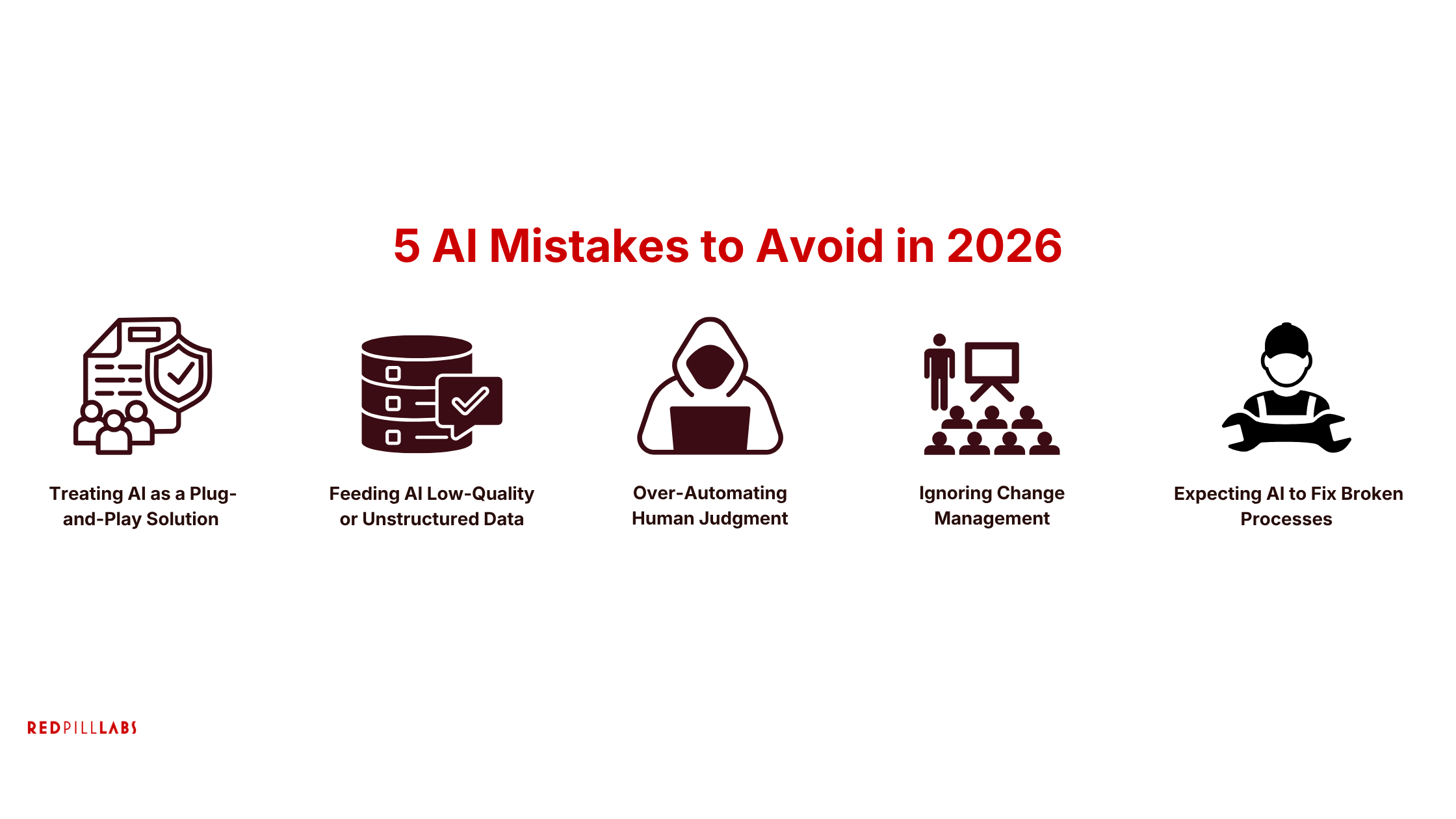
1. Treating AI as a Plug-and-Play Solution
One of the biggest misconceptions is that AI tools can simply be turned on and instantly solve problems.
In reality, AI systems need context, structure, and clear objectives to produce useful outcomes.
Without proper setup, AI will often generate generic, inconsistent, or irrelevant outputs.
Most AI tools are optimized for generic use cases, not your specific workflows, meaning out-of-the-box results often reflect statistical averages rather than operational reality.
Without constraint design (clear inputs, guardrails, and output structure), AI will default to plausible-sounding but low-accountability responses.
How to avoid it:
Define the specific problem you are trying to solve before introducing AI.
Map out inputs, desired outputs, and how success will be measured.
AI should support a process, not replace understanding of it.
2. Feeding AI Low-Quality or Unstructured Data
AI systems are only as good as the data they are trained on or given.
Poorly structured spreadsheets, outdated information, or inconsistent formatting will lead to unreliable outputs.
This is especially common when businesses try to connect AI to legacy systems without cleaning or standardizing data first.
What often gets missed is that AI doesn’t just inherit data quality issues, it compounds them by confidently filling gaps with assumptions.
In enterprise settings, this creates a “false precision” problem where outputs look correct enough to trust, but are actually built on inconsistent foundations.
How to avoid it:
Invest time in data hygiene.
Standardize formats, remove duplicates, and ensure your data sources are accurate and current.
If your data is messy, AI will simply scale the mess.
3. Over-Automating Human Judgment
AI is excellent at pattern recognition and repetitive tasks, but it is not a replacement for human judgment, especially in areas like hiring, finance decisions, compliance, or customer escalation.
Over-reliance on AI can lead to decisions that are technically efficient but strategically or ethically flawed.
The real risk is not bad decisions, but the removal of context from decisions that were previously made with tacit organizational knowledge.
Once that context is removed, you create systems that optimize for efficiency metrics while drifting away from business intent.
How to avoid it:
Use AI as a decision-support tool, not a decision-maker.
Maintain a human in the loop approach, especially when AI is involved in high-impact or sensitive processes.
4. Ignoring Change Management
Even the best AI system will fail if people do not use it properly.
Resistance often comes from fear, lack of training, or unclear expectations around how AI fits into daily work.
Many organizations focus heavily on implementation and completely overlook adoption.
AI adoption fails less because of technical limitations and more because users quietly route around systems that don’t fit their day-to-day reality.
If the workflow adds friction or feels disconnected from how people actually work, they will revert to manual processes even if the AI is technically “better.”
How to avoid it:
Train users early, explain the purpose behind the AI tools, and integrate them into existing workflows rather than forcing entirely new ones.
Adoption is just as important as deployment.
5. Expecting AI to Fix Broken Processes
AI is often introduced into environments with inefficient or poorly designed processes under the assumption that it will “solve” them.
In reality, AI amplifies whatever it is given, whether good or bad.
If your workflow is broken, AI will simply make the broken parts happen faster.
AI tends to expose process inefficiencies faster than it solves them, especially in workflows with unclear ownership or redundant approval layers.
In these environments, AI doesn’t simplify operations, it accelerates confusion at scale.
How to avoid it:
Optimize and simplify processes before layering AI on top.
Ask whether the workflow should exist at all, not just how AI can improve it.
Final Thoughts
Most AI failures are not model failures, they are system design failures.
The gap between “using AI” and “getting value from AI” is almost always determined by how well organizations define constraints, structure data, and preserve human context in decision-making.
The organizations seeing real ROI from AI are not the ones deploying the most tools, but the ones treating AI as an extension of process architecture rather than a standalone capability.
They invest as much in workflow redesign and data discipline as they do in model selection.
Ultimately, AI does not eliminate operational complexity, it redistributes it.
If that complexity is not intentionally designed for, it reappears as noise, inconsistency, and overconfident outputs at scale.