3 Latest HR Trends to Watch
1. AI Is Moving From HR Experiment to Workforce Strategy
The latest trends suggest that organizations’ focus is shifting from whether organizations should use AI to how AI should change the way work gets done.
ADP Canada's 2026 research identifies responsible AI adoption as one of the key trends shaping Canadian workplaces.
Organizations are exploring AI across areas such as recruitment, onboarding, workforce analytics, talent management, and payroll, while also considering privacy, transparency, ethics, and human oversight.
The challenge is that implementing an AI tool does not automatically create value.
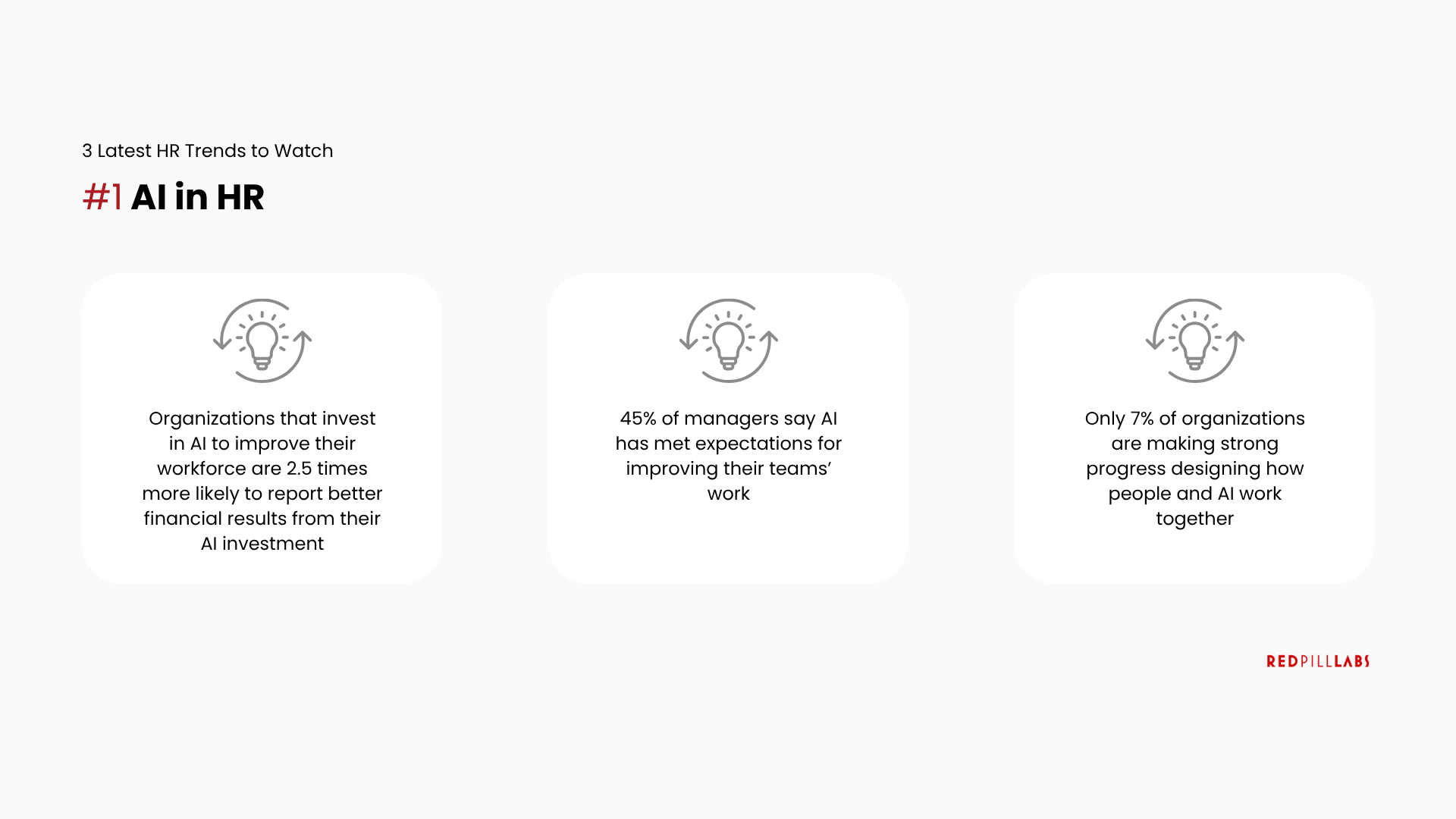
Gartner found that 45% of managers surveyed in July 2025 said AI had improved their teams’ work as much as they expected. At the same time, only 14% of managers surveyed said they faced no challenges when trying to drive effective AI use across their teams.
Gartner's research shows that AI adoption is also creating a new responsibility for managers.
In a Gartner survey, 45% of managers said AI had improved their teams' work as much as they expected. However, only 14% of managers reported facing no challenges when trying to drive effective AI use across their teams.
That gap matters for HR.
Employees may have access to AI tools, but organizations still need to determine how those tools fit into existing workflows, decision making and responsibilities.
Deloitte’s 2026 Global Human Capital Trends research points to a similar issue.
The research found that 93% of AI investment is going toward technology, while only 7% is focused on people and the broader work required to make AI effective.
Only 7% of organizations say they are making strong progress in intentionally designing how people and AI work together.
Organizations leading in this area are nearly 2.5 times more likely to report better financial results.
For HR leaders, the questions are therefore becoming less about the technology itself and more about how work needs to change around it:
Which tasks should be automated?
Where should employees continue making decisions?
What AI skills do employees need?
How should managers lead teams using AI?
What policies are needed around privacy, data, and responsible use?
How should productivity gains from AI be measured?
2. Skills-Based Workforce Planning Is Becoming More Important
Rather than relying exclusively on traditional job titles and organizational structures, HR teams are increasingly looking at workforce capabilities at the skills level.
ADP Canada’s 2026 research found that Canadian organizations are reassessing their skills inventories as workforce requirements change.
Employers continue to place importance on skills such as work ethic, attention to detail, time management, problem solving and teamwork.
At the same time, larger organizations recognize the growing importance of AI skills for competitiveness, even though relatively few are actively hiring for these capabilities.
This creates a challenge for traditional workforce planning.
Mercer's 2026 Global Talent Trends research, based on a survey of nearly 12,000 executives, HR leaders, employees, and investors across 16 geographies and 16 industries, identifies workforce intelligence and changing skill requirements as major priorities for organizations.
Mercer specifically points to the need to identify capability gaps, understand workforce risks, and move talent more effectively as organizations respond to the AI skills gap and changing business requirements.
For HR teams, this could mean moving toward a more dynamic approach to workforce planning.
This shifts the workforce planning question from “How many employees do we need” to “what capabilities will we need, where do we have them today, and how can we develop or acquire them”.
That change can affect nearly every part of the employee lifecycle, including:
Recruiting
Learning and development
Succession planning
Internal mobility
Organizational design
Workforce planning
It also creates an opportunity to make better use of existing HR data.
Skills, performance, compensation, turnover, recruiting and workforce planning data can provide a much clearer picture of organizational capability when they are connected rather than viewed separately.
3. HR Is Being Pushed Further Into Strategic Decision-Making
As organizations navigate AI adoption, changing workforce requirements, and economic uncertainty, HR is increasingly expected to provide insight into questions that directly affect business performance.
Mercer's 2026 Global Talent Trends research describes HR as entering a new era in which the function is being pushed to become more strategic in shaping work, skills, and organizational effectiveness.
Deloitte's research points in a similar direction.
Its 2026 report argues that organizations need to intentionally combine human creativity, judgment, and adaptability with the scale and speed of AI.
For HR leaders, this means workforce information is becoming increasingly important to business decision-making.
Questions that were once primarily considered HR issues are increasingly business questions:
Where are we experiencing critical talent gaps?
Which roles are likely to change because of AI?
Where are we losing high-value employees?
Do our compensation structures support the skills we need?
Which capabilities should we develop internally?
How should our workforce change as the business grows?
Are our HR processes creating unnecessary friction for employees?
ADP Canada also identifies stronger collaboration between HR and IT as an emerging trend.
As technology becomes more deeply embedded in workforce management, the two functions increasingly need to work together on implementation, data, adoption, security, and employee experience.
The result is a broader shift in what organizations expect from HR. The function is increasingly being asked not simply to administer the workforce, but to help organizations understand, plan, and optimize it.
What These Trends Mean for HR Leaders

For organizations, the priority should not necessarily be adopting every new HR technology or AI capability as quickly as possible.
Instead, HR leaders should focus on whether their people, processes, data, and technology are aligned with the organization's actual business priorities.
A practical starting point is to assess three areas:
1. AI readiness: Where can AI create meaningful value, and what governance is needed to use it responsibly?
2. Workforce capabilities: What skills does the organization have today, and where are the most important gaps?
3. Workforce intelligence: Can HR and business leaders access the data they need to make informed decisions about people, skills, costs, and organizational performance?
References
ADP Canada. Canada Workplace Trends for 2026. 2025.
Gartner. HR Survey Reveals 45% of Managers Report AI Has Lived Up to Their Expectations in Improving Their Teams’ Work. March 4, 2026.
Deloitte. 2026 Global Human Capital Trends: From Tensions to Tipping Points: Choosing the Human Advantage. 2026.
Mercer. Global Talent Trends 2026: Solving the Human Machine Equation. 2026.