5 AI Use Cases for Payroll Reporting
blog/5-ai-use-cases-for-payroll-reporting | AI Articles
2026-27-22

Payroll teams may have access to detailed information on earnings, hours, deductions, overtime, headcount, departments, and locations, but extracting meaningful insights can still require significant manual work.
AI, as a tool, can help address some of these challenges.
It’s important to remember that the value that payroll teams will receive from any given tool is dependent on the information it can access and the quality of that data.
Learn more: What Is MCP in AI? A Comprehensive Breakdown of Model Context Protocol
5 AI Use Cases Payroll Teams Can Use to Solve Common Pain Points in Reporting
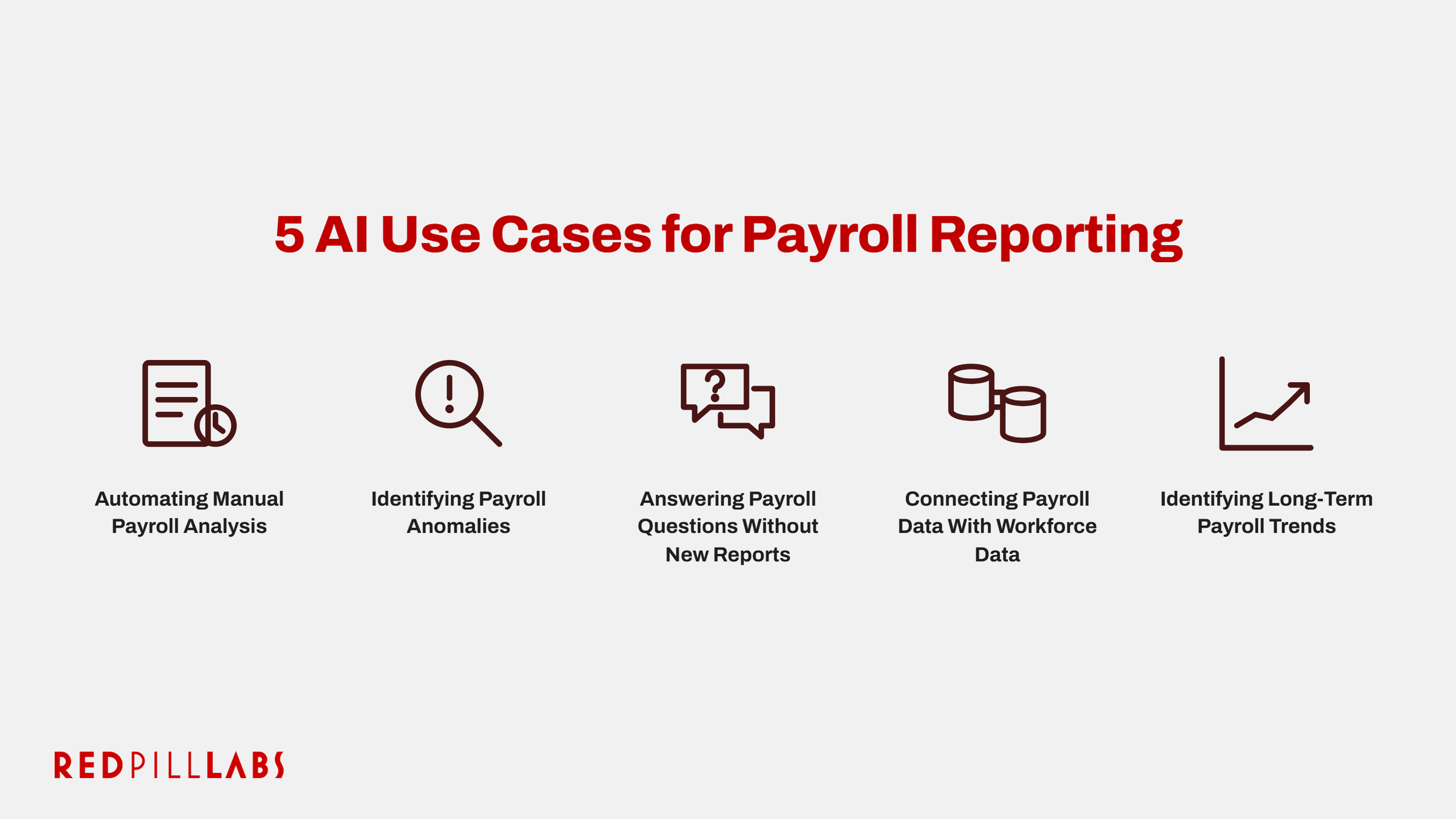
1. Automating Manual Payroll Analysis
Too Much Time Spent Building and Rebuilding Reports
Payroll teams often receive recurring requests for information that should be relatively straightforward to produce.
A manager may want payroll costs by department, Finance may need labour costs for a forecast, and HR may need overtime or earnings information for workforce analysis.
The problem is that these requests do not always fit neatly into an existing report.
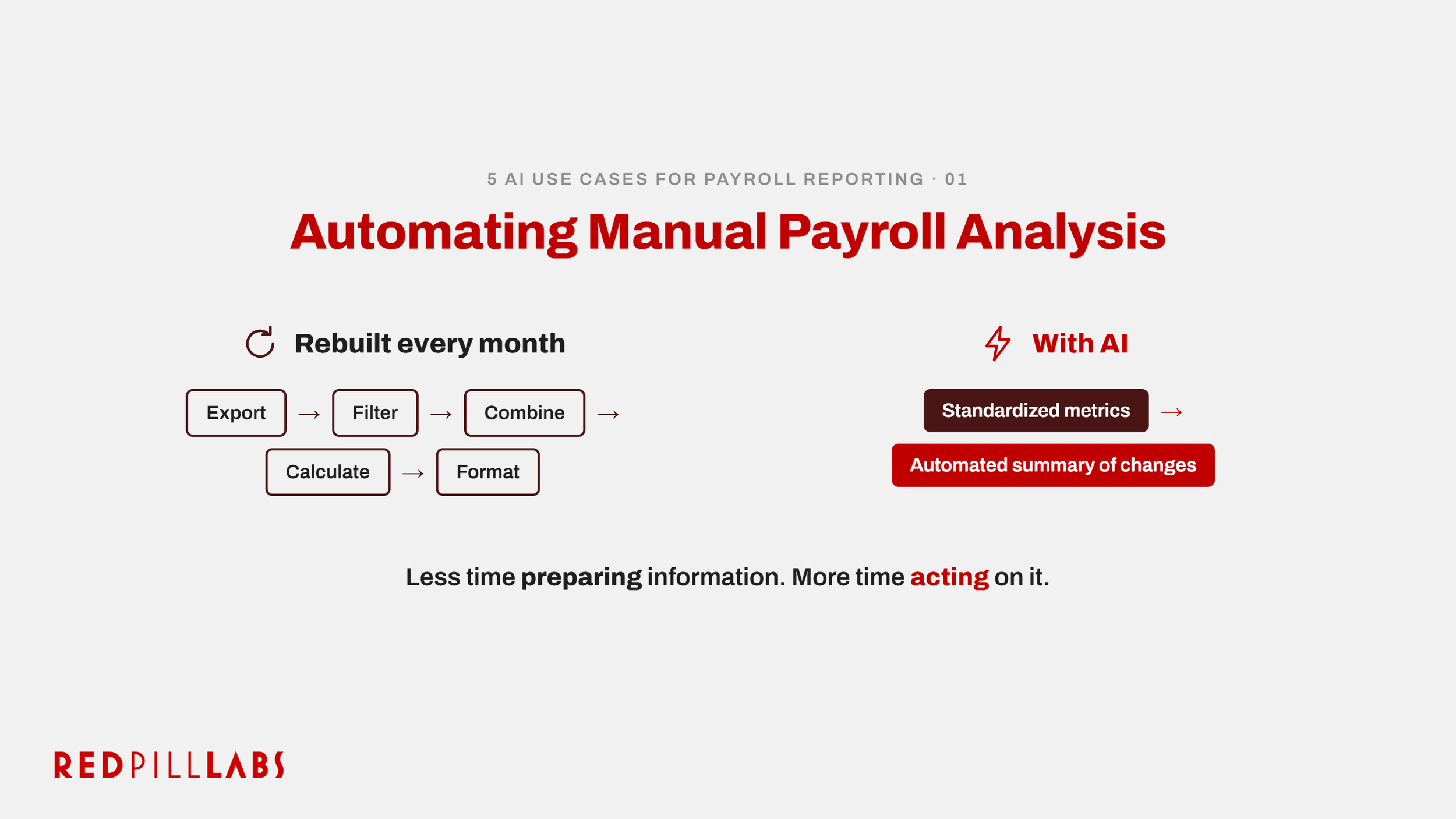
Someone may need to export payroll data, filter employees, manipulate spreadsheets, combine information from multiple reports, calculate additional metrics, and format the results before the information can even be reviewed.
When the same request comes back the following month, much of that work may have to be repeated.
How can AI help?
AI can automate recurring analysis using established payroll data and reporting definitions.
Rather than rebuilding reports each month, organizations can establish standardized metrics and have AI generate summaries of changes in payroll costs, earnings, hours, overtime, headcount, and other measures.
This can reduce repetitive reporting work while making recurring analysis more consistent.
The larger opportunity is not simply automating the report itself.
It is automating the analysis of the report, so payroll teams spend less time preparing information and more time acting on it.
2. Identifying Payroll Anomalies
Unusual Payroll Results Can Be Difficult to Identify and Investigate
Payroll teams must review large volumes of data across pay periods, departments, locations, and employee groups.
Unusual results can easily be overlooked, particularly when they are buried within otherwise routine reporting.
For example, overtime costs may increase significantly within one department, an employee's earnings may change unexpectedly, or a location may experience a substantial increase in payroll expenses.
Identifying these changes is only part of the challenge.
Payroll teams must also determine whether the results are expected and what caused them.
A payroll expense increase could be driven by headcount growth, compensation changes, overtime, bonuses, retroactive payments, or a combination of several factors.
Investigating these changes can require comparing multiple reports and manually drilling into individual data points.
How can AI help?
AI can analyze payroll data against historical patterns and established thresholds to flag potential anomalies, such as:
Unusual increases in overtime
Significant changes in employee earnings
Unexpected payroll variances
Abnormal hours worked
Sudden increases in retroactive payments
Payroll costs that differ significantly from historical trends
AI can then help investigate the factors contributing to these changes.
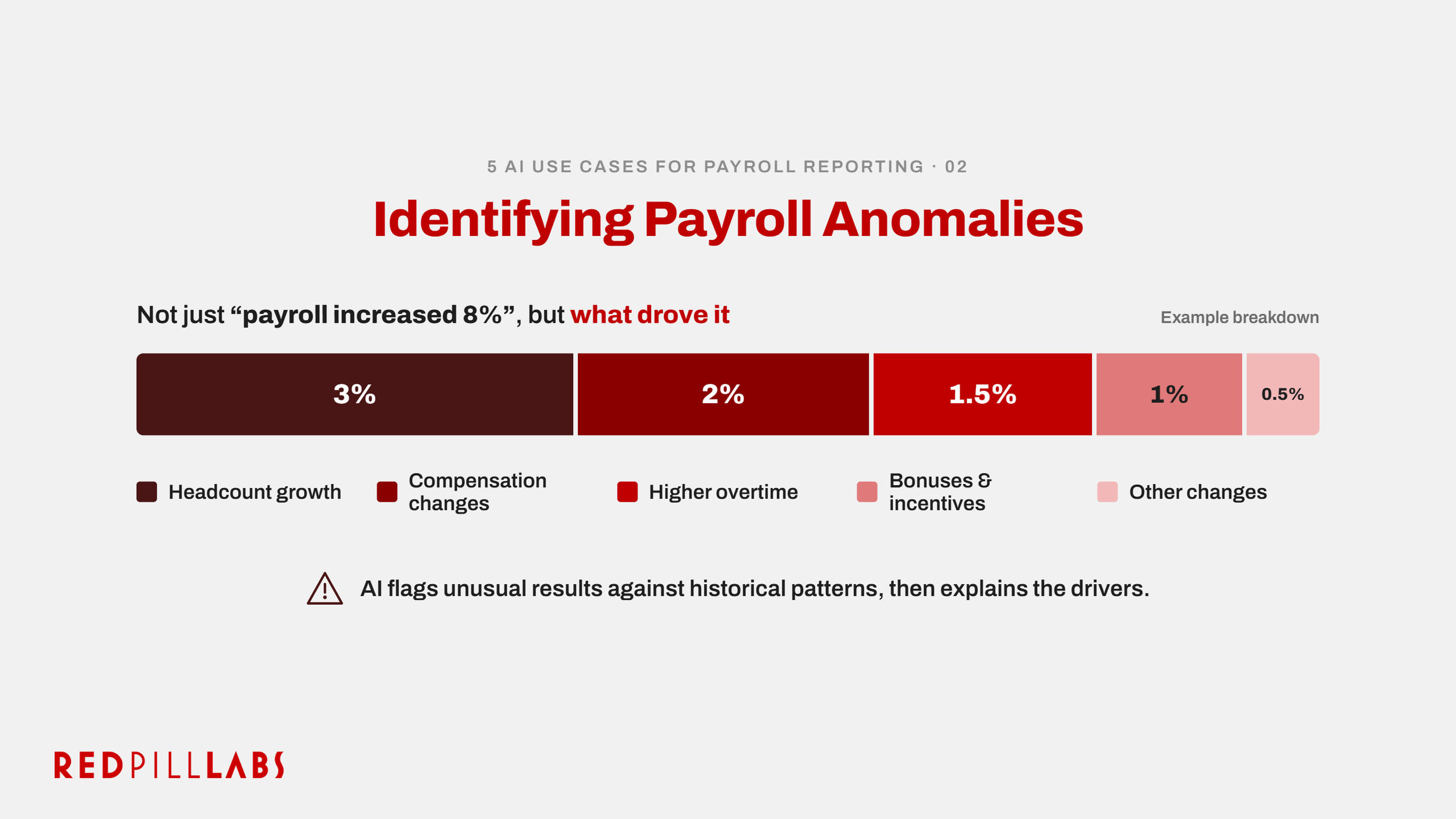
For example, instead of simply reporting that payroll increased by 8%, an AI-enabled analysis could identify that the increase was primarily associated with:
3% headcount growth
2% compensation changes
1.5% higher overtime
1% in bonuses and incentives
0.5% in other payroll changes
This helps payroll and Finance teams identify unusual results and understand what is driving them, reducing the time spent manually investigating variances.
3. Answering Payroll Questions Without Building New Reports
Simple Questions Can Require Complicated Reporting Processes
Payroll teams regularly receive questions that require access to information already contained within their payroll systems.
A manager may ask which department has the highest overtime costs.
Finance may want to know how labour costs have changed over the last 12 months. HR may want to compare average earnings between locations.
While these questions may sound simple, answering them can require someone to identify the appropriate data, build or modify a report, apply filters, calculate additional metrics, and validate the results.
As the number of requests increases, payroll teams can spend a significant amount of time acting as a reporting function for the rest of the organization.
How can AI help?
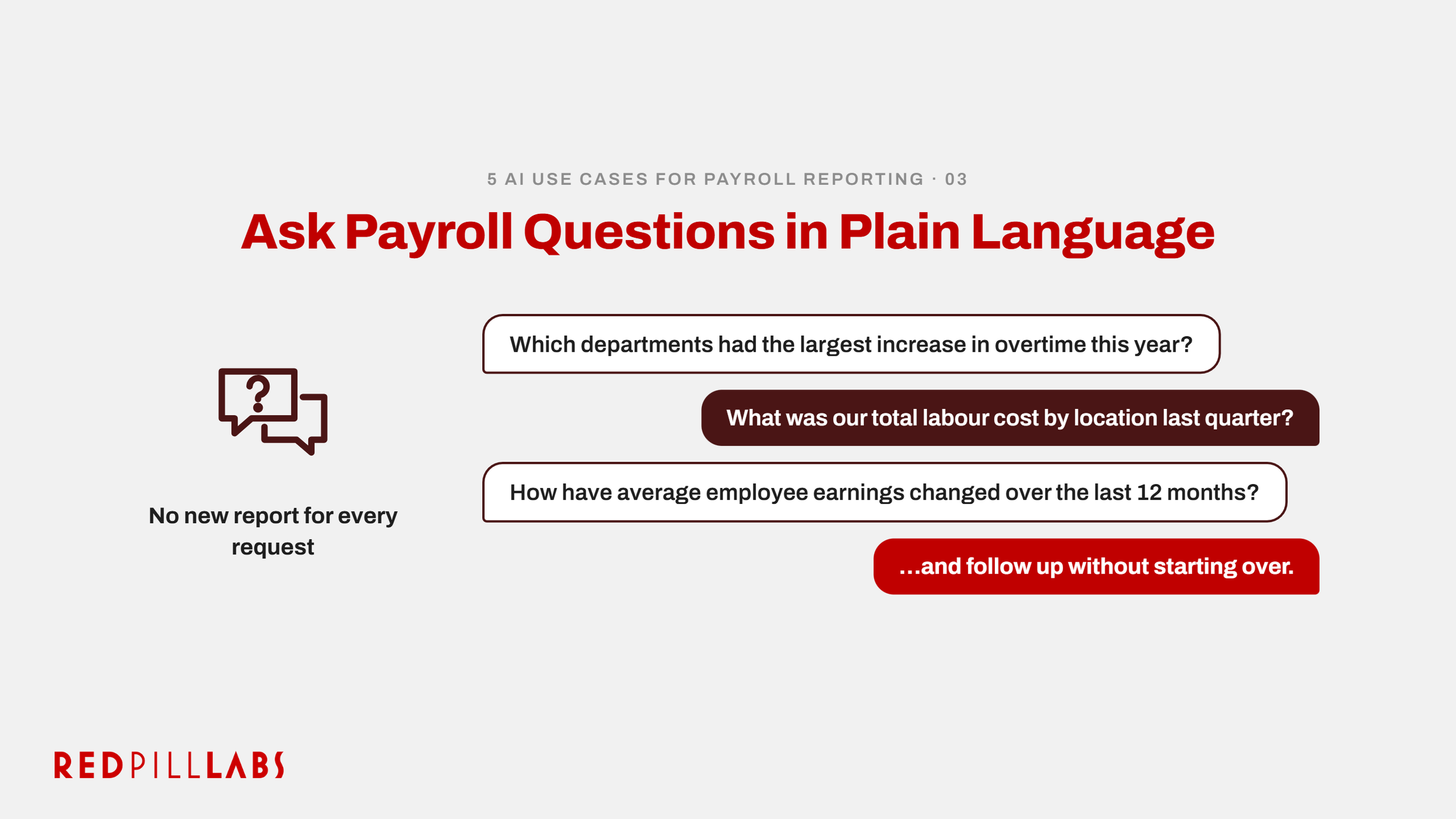
AI can allow authorized users to ask questions about payroll data using natural language rather than requiring a new report for every question.
For example, a user could ask:
Which departments had the largest increase in overtime this year?
What was our total labour cost by location last quarter?
How has average employee earnings changed over the last 12 months?
Which employee groups experienced the largest change in hours worked?
Users can then ask follow-up questions without starting the reporting process over again.
This can make payroll information more accessible while reducing the number of ad hoc reporting requests that payroll teams need to manually fulfill.
4. Connecting Payroll Data With Workforce Data
Payroll Data Alone Does Not Always Explain What Is Driving Labour Costs
Payroll reporting can show how much an organization is spending, but it does not always explain what is driving those costs.
For example, a department may experience a significant increase in overtime.
Payroll can show the additional overtime hours and associated costs, but it may not explain whether the increase is related to vacancies, absenteeism, increased demand, scheduling changes, or other workforce factors.
The information needed to answer those questions may exist in separate HR, time and attendance, scheduling, or workforce management systems.
Without bringing that information together, payroll teams may have to manually compare data from multiple sources to understand what is happening.
How can AI help?
AI can analyze payroll alongside other workforce data to identify relationships between payroll results and the factors that may be contributing to them.
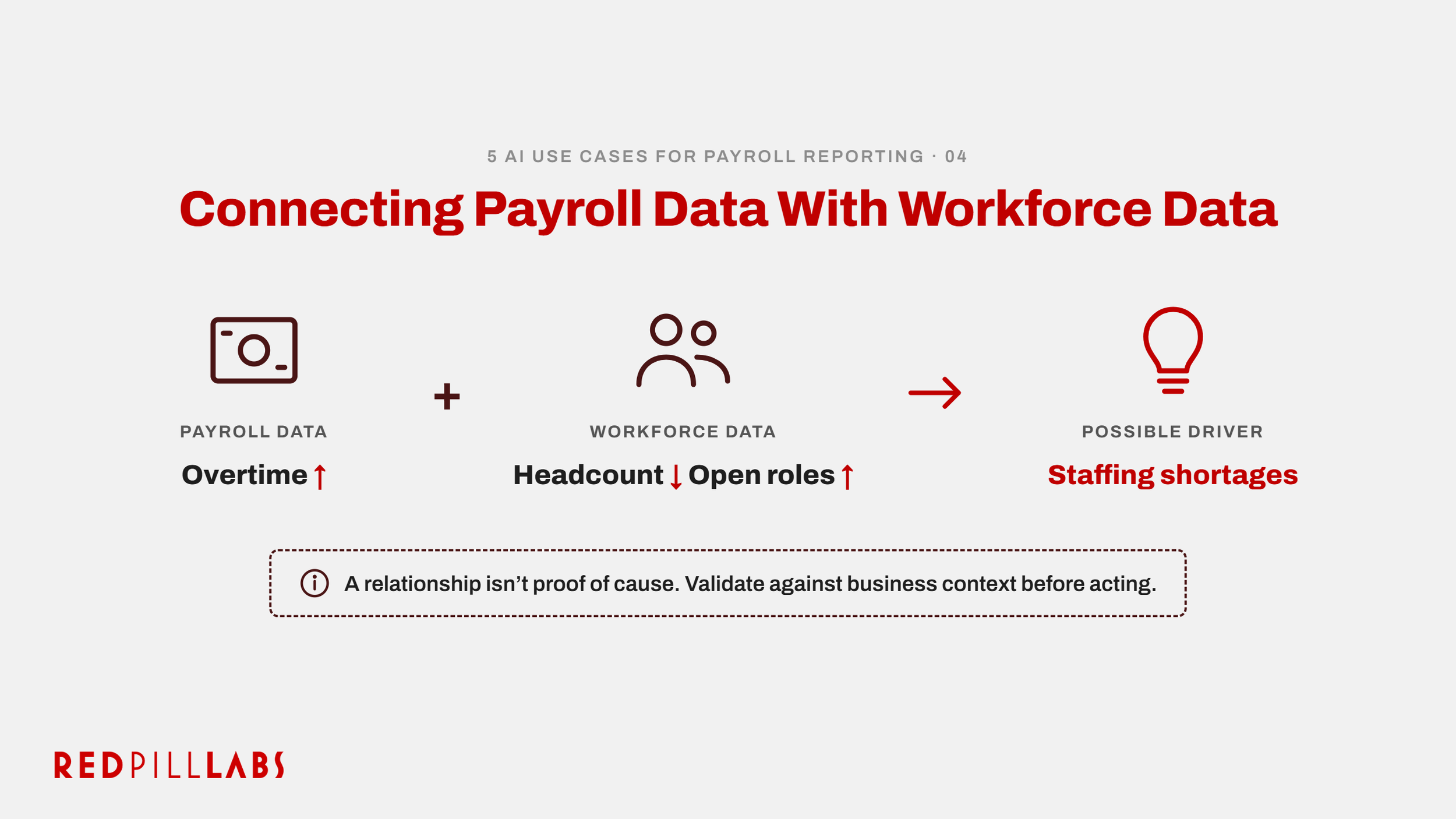
For example, AI could identify that overtime increased in a department while headcount declined and open positions increased.
Connecting these metrics can help highlight a potential relationship between staffing shortages and rising overtime costs.
This gives organizations a more complete picture of their workforce expenses and helps them investigate the operational factors behind payroll results.
However, identifying a relationship does not automatically establish causation.
These insights should be validated against the underlying business context before decisions are made.
5. Identifying Long-Term Payroll Trends
Gradual Changes Can Go Unnoticed Until They Become Larger Problems
Individual payroll reports typically focus on a specific pay period or month. While this is useful for reviewing immediate results, it can make gradual changes harder to recognize.
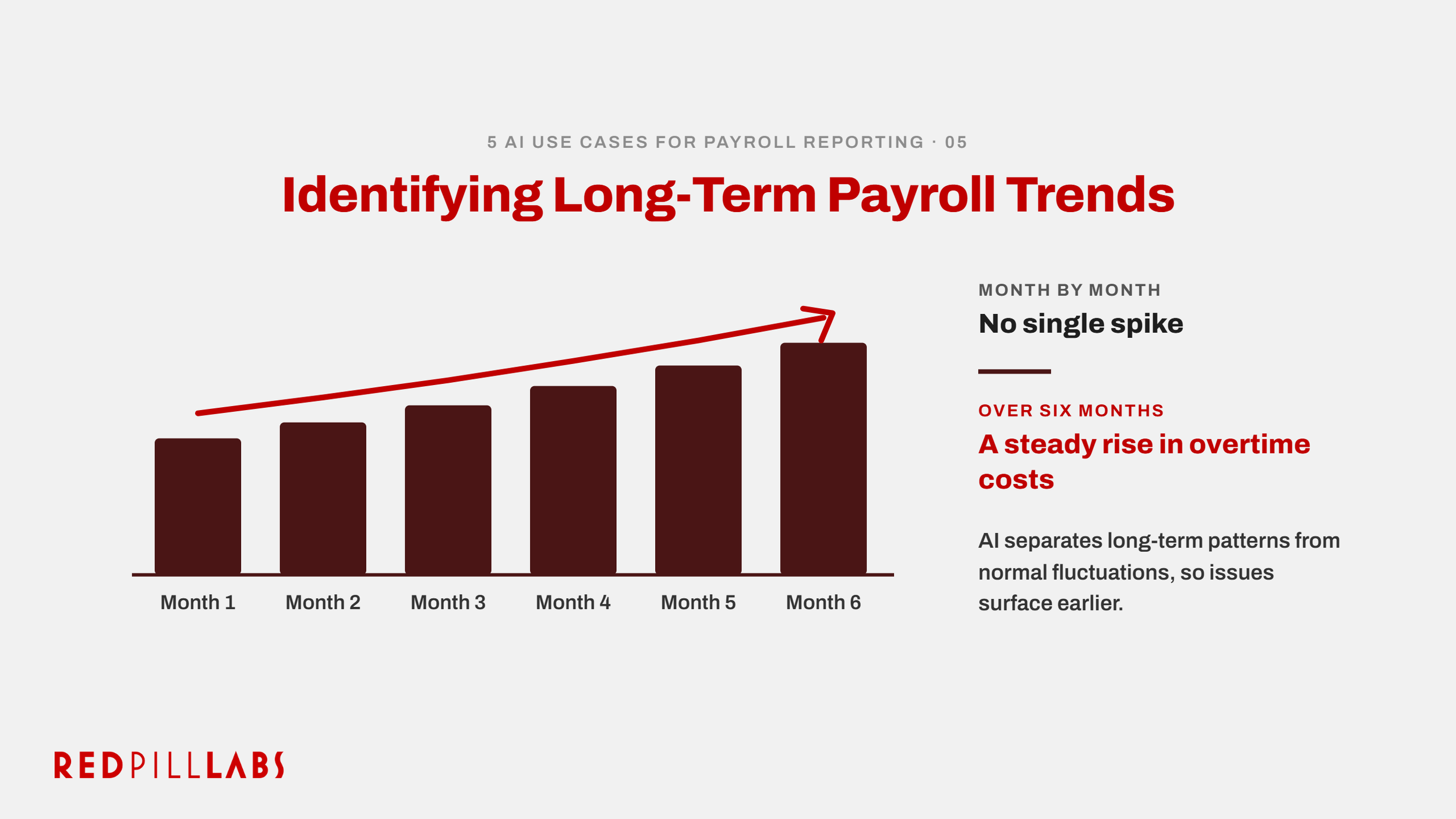
Overtime costs may increase slightly every month, labour costs per employee may steadily rise, or average hours worked may change over several quarters.
When teams review each reporting period independently, these patterns can be difficult to distinguish from normal fluctuations. By the time a trend becomes obvious, the organization may have already experienced months of additional costs or operational pressure.
How can AI help?
AI can analyze historical payroll data to identify patterns across longer periods and highlight changes that may warrant further investigation.
For example, it could identify a consistent increase in overtime costs over six months, even if no individual month showed an unusually large spike.
Other potential insights include steadily increasing labour costs per employee, recurring payroll variances in a particular location, or sustained changes in average hours worked.
By distinguishing longer-term patterns from short-term fluctuations, AI can help payroll and business leaders recognize emerging issues and investigate them earlier.
Building the Foundation for AI-Enabled Payroll Reporting
What’s key is to ensure that AI works from trusted data and clearly defined metrics.
When payroll data is inconsistent or metrics are defined differently across departments, AI may produce inaccurate or conflicting insights.
Establishing reliable data sources and consistent metric definitions helps ensure that AI can interpret payroll information accurately and generate insights that are meaningful to the business.
With the right foundation, AI can help organizations move beyond traditional payroll reporting to better understand cost drivers, identify trends, and make more informed decisions.