blog/guide-to-dayforce-agentic-hcm-platform | Dayforce Resources
2026-11-18
Tuesday, October 27, 2026 , at its annual Dayforce Discover conference, Dayforce unveiled its Agentic HCM Platform, marking a significant evolution in how organizations can manage their workforce.
The announcement introduced a new generation of AI-powered capabilities designed to move beyond traditional automation, bringing intelligence, decision-making, and action directly into everyday HR and business operations.
What is the Dayforce Agentic HCM Platform?
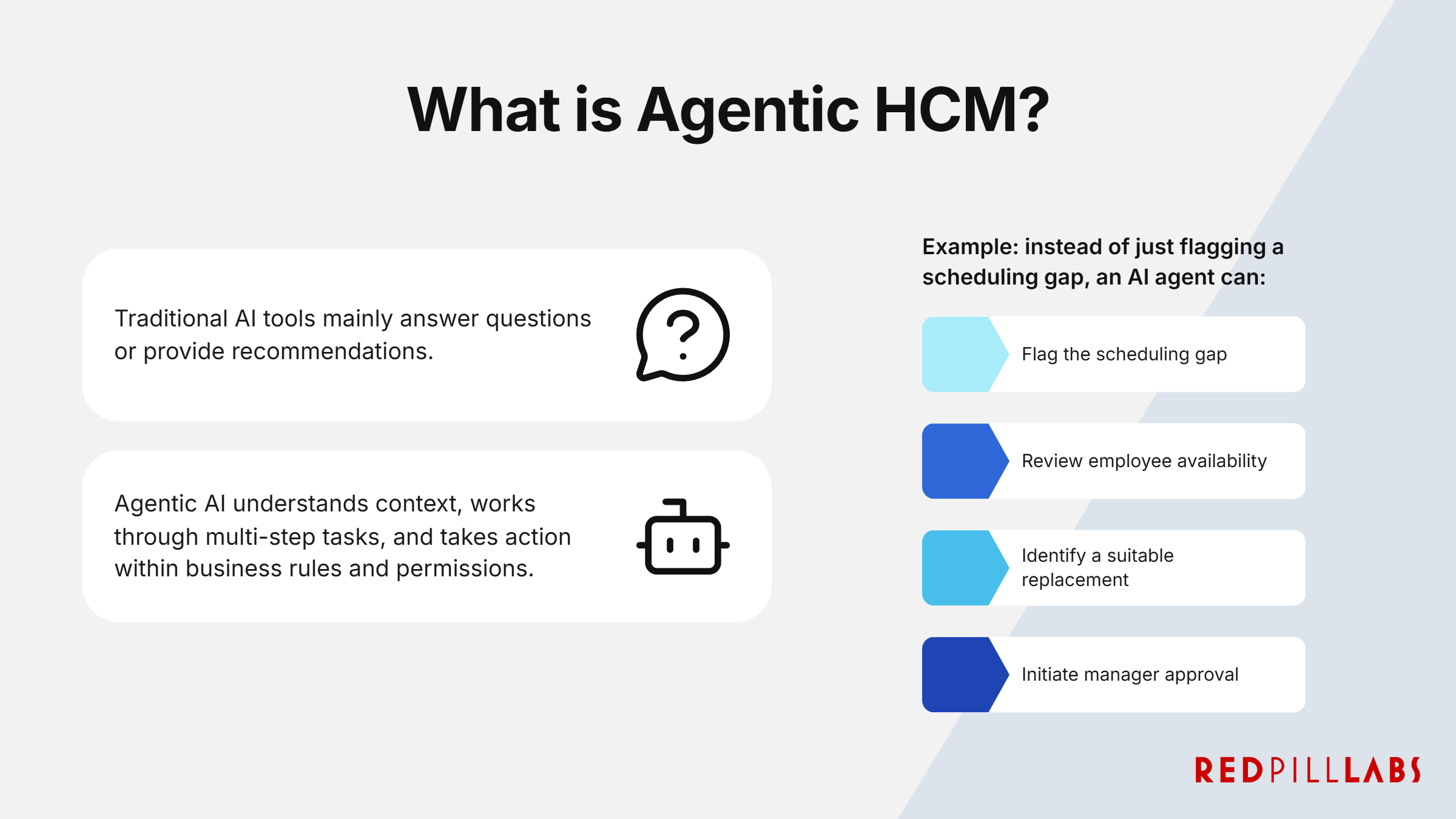
Agentic Human Capital Management (HCM) integrates AI agents directly into HR, payroll, workforce management, and other business processes.
Unlike traditional AI tools that primarily answer questions or provide recommendations, agentic AI can understand context, work through multi-step tasks, identify issues, and take action within defined business rules and permissions.
For example, rather than simply flagging a scheduling gap, an AI agent could review employee availability, identify a suitable replacement, and initiate the necessary steps for manager approval.
The key difference is that AI moves beyond providing information to actively helping organizations complete work.
How does Dayforce approach Agentic HCM?
Dayforce's approach is built around integrating AI natively into its existing HCM ecosystem rather than relying exclusively on separate, disconnected AI applications.
The platform brings together workforce information, organizational structures, business rules, permissions, and workflows through a connected foundation.
This gives AI agents access to the context needed to support workforce-related decisions and actions.
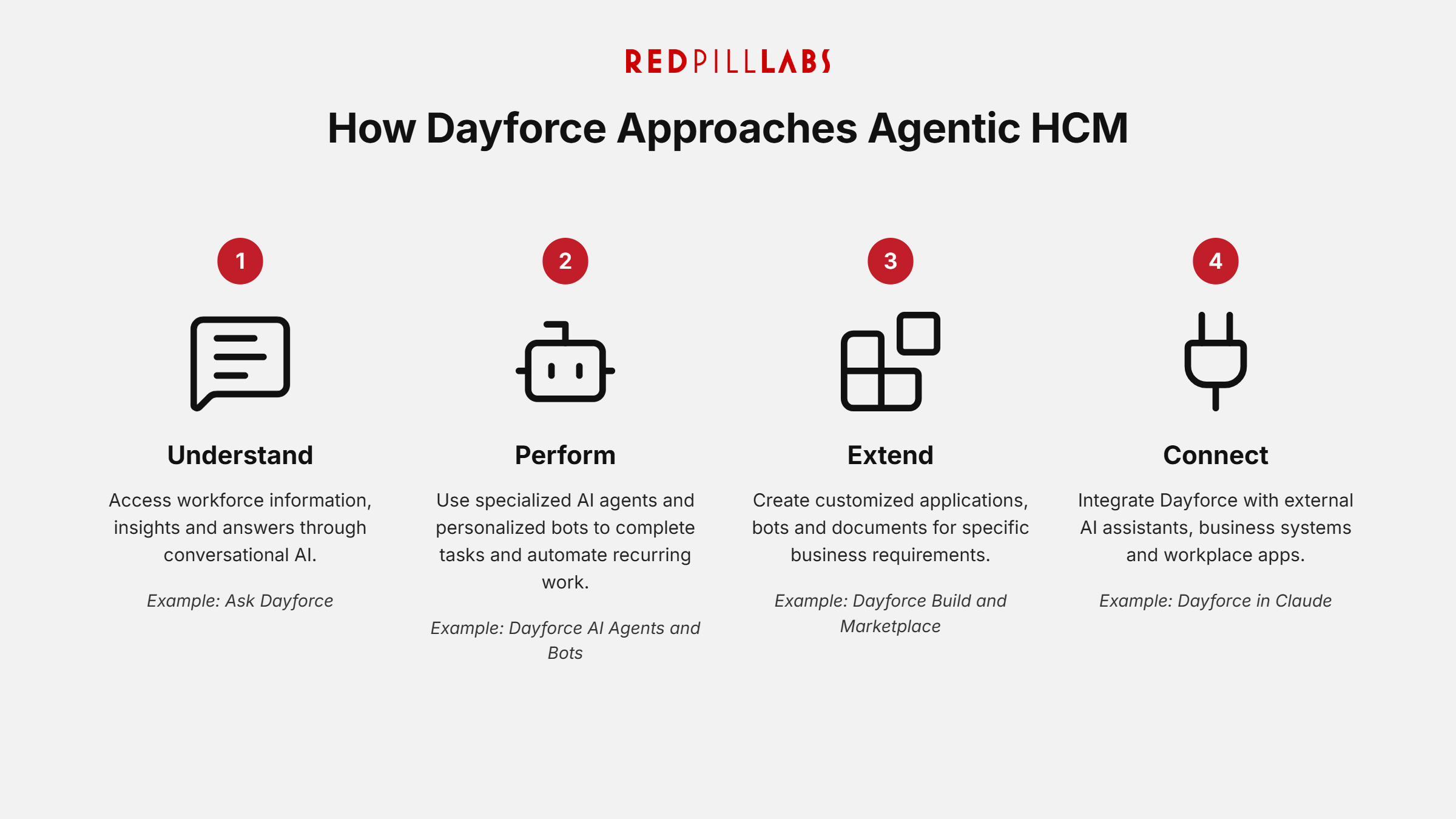
Dayforce describes its Agentic HCM vision through four connected capabilities:
Understand: Help employees and managers access workforce information, insights, and answers through conversational AI.
Perform: Use specialized AI agents and personalized bots to complete tasks, coordinate workflows, and automate recurring work.
Extend: Allow organizations to create customized applications, bots, and documents that address their specific business requirements.
Connect: Integrate Dayforce with external AI assistants, business systems, and workplace applications through governed connections.
Together, these capabilities aim to make Dayforce more than a system of record. The platform is evolving into a system that can help organizations understand what is happening, determine what needs to happen next, and move work forward.
The Core Components of the Dayforce Agentic HCM Platform
Dayforce introduced several new products and capabilities as part of its Agentic HCM announcement. Each serves a different purpose, but they are designed to work together within the broader platform.
1. Ask Dayforce: A Conversational AI Experience
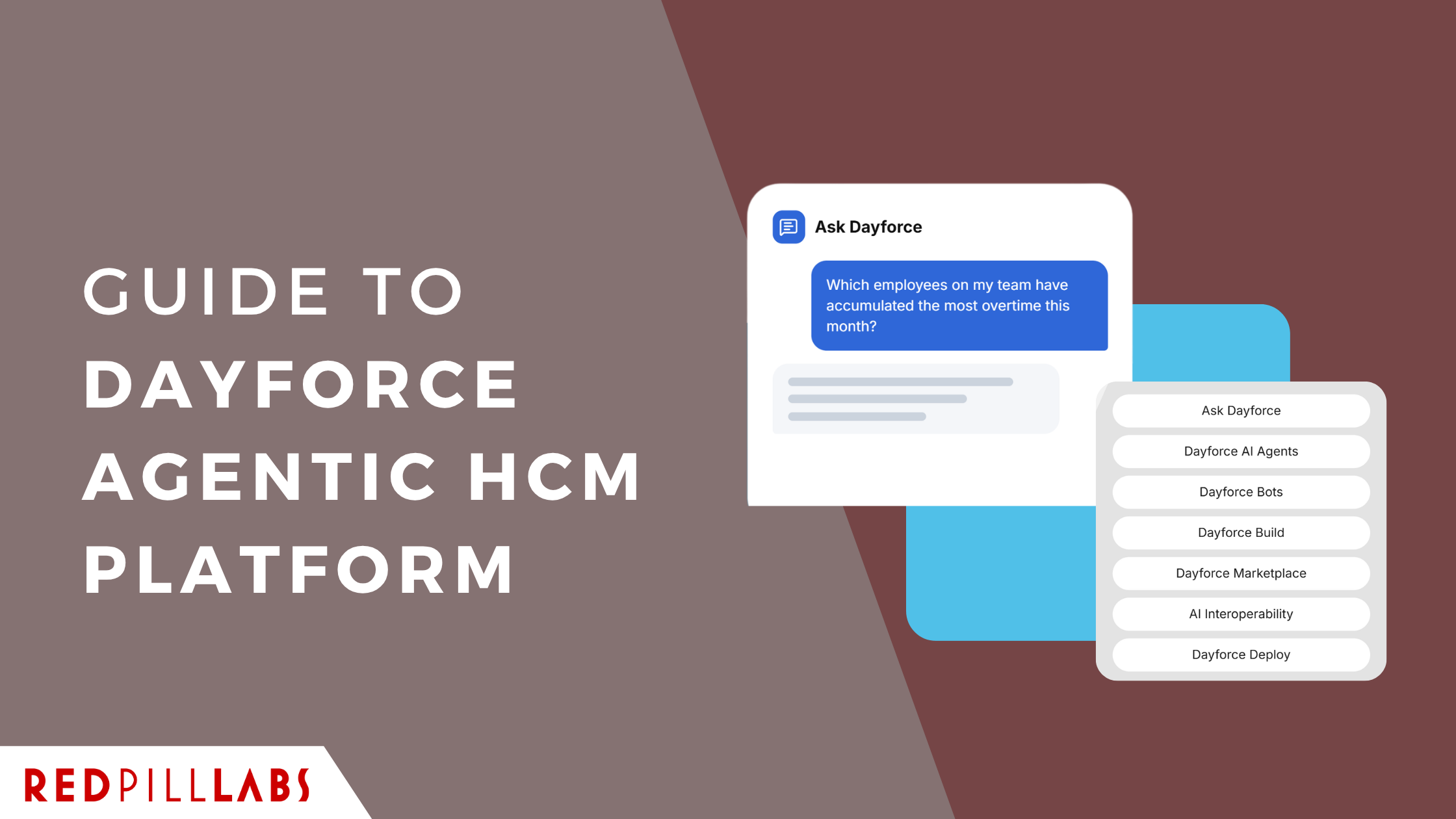
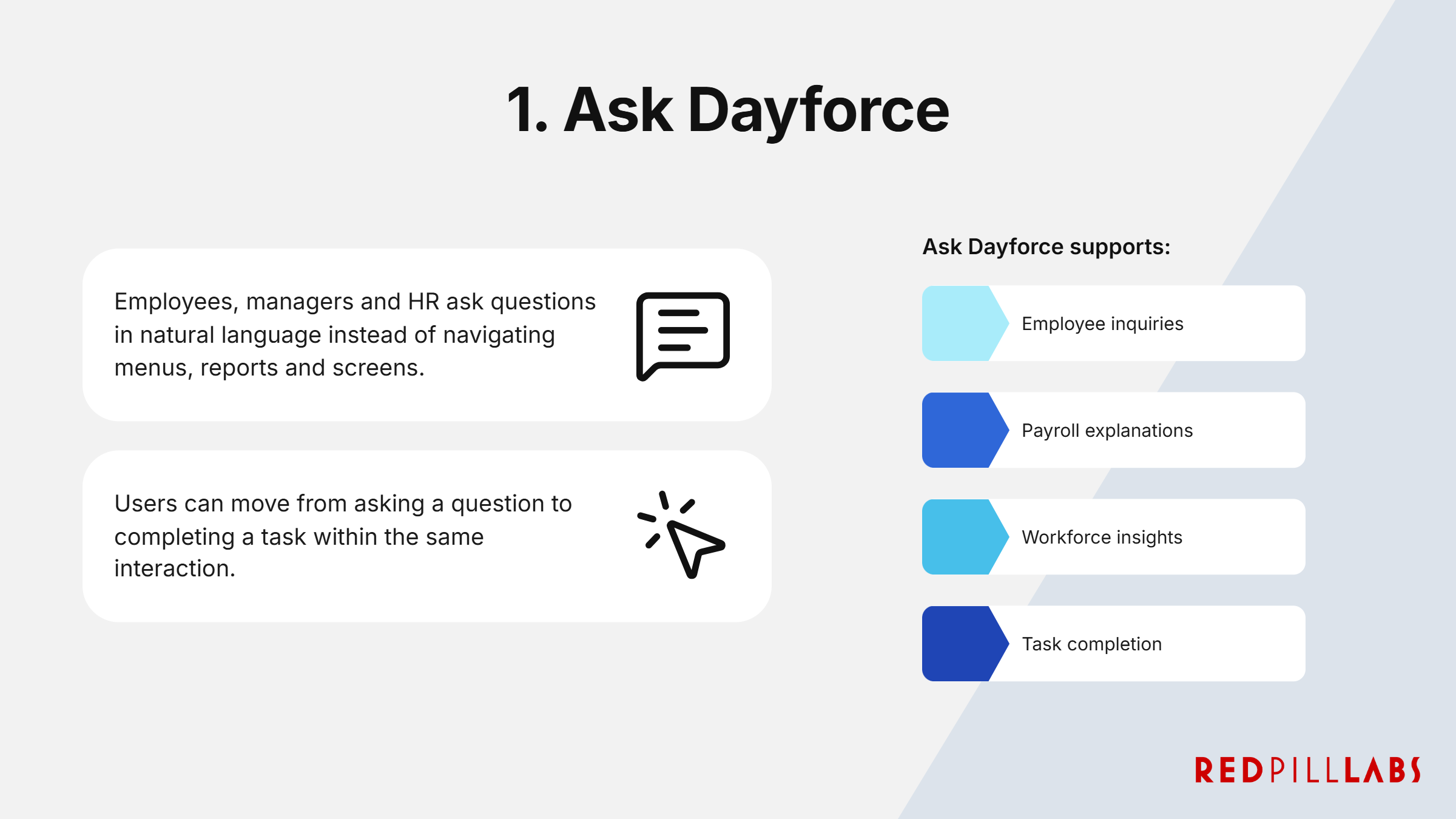
Ask Dayforce is a reimagined conversational experience that allows employees, managers, and HR professionals to interact with Dayforce using natural language.
Rather than navigating multiple menus, reports, and screens to find information, users can ask questions or describe what they want to accomplish.
The experience extends across the Dayforce platform, allowing users to move from asking questions to completing tasks within the same interaction.
Potential use cases include:
Employee inquiries: Employees can ask questions about their pay, benefits, time off, schedules, and other employment-related information.
Payroll explanations: Employees can request clarification about changes in their pay, deductions, or earnings.
Workforce insights: Managers can ask questions about overtime trends, employee attendance, labour costs, and workforce performance.
HR support: HR professionals can retrieve relevant employee information and navigate administrative processes more efficiently.
Task completion: Users can move beyond receiving information and initiate supported actions through conversational instructions.
For example, a manager could ask, "Which employees on my team have accumulated the most overtime this month?" Rather than manually filtering reports, the conversational experience can help surface the relevant workforce information and guide the manager toward appropriate next steps.
The goal is to make workforce information more accessible while reducing the time spent navigating the system.
2. Dayforce AI Agents: Moving Beyond Recommendations
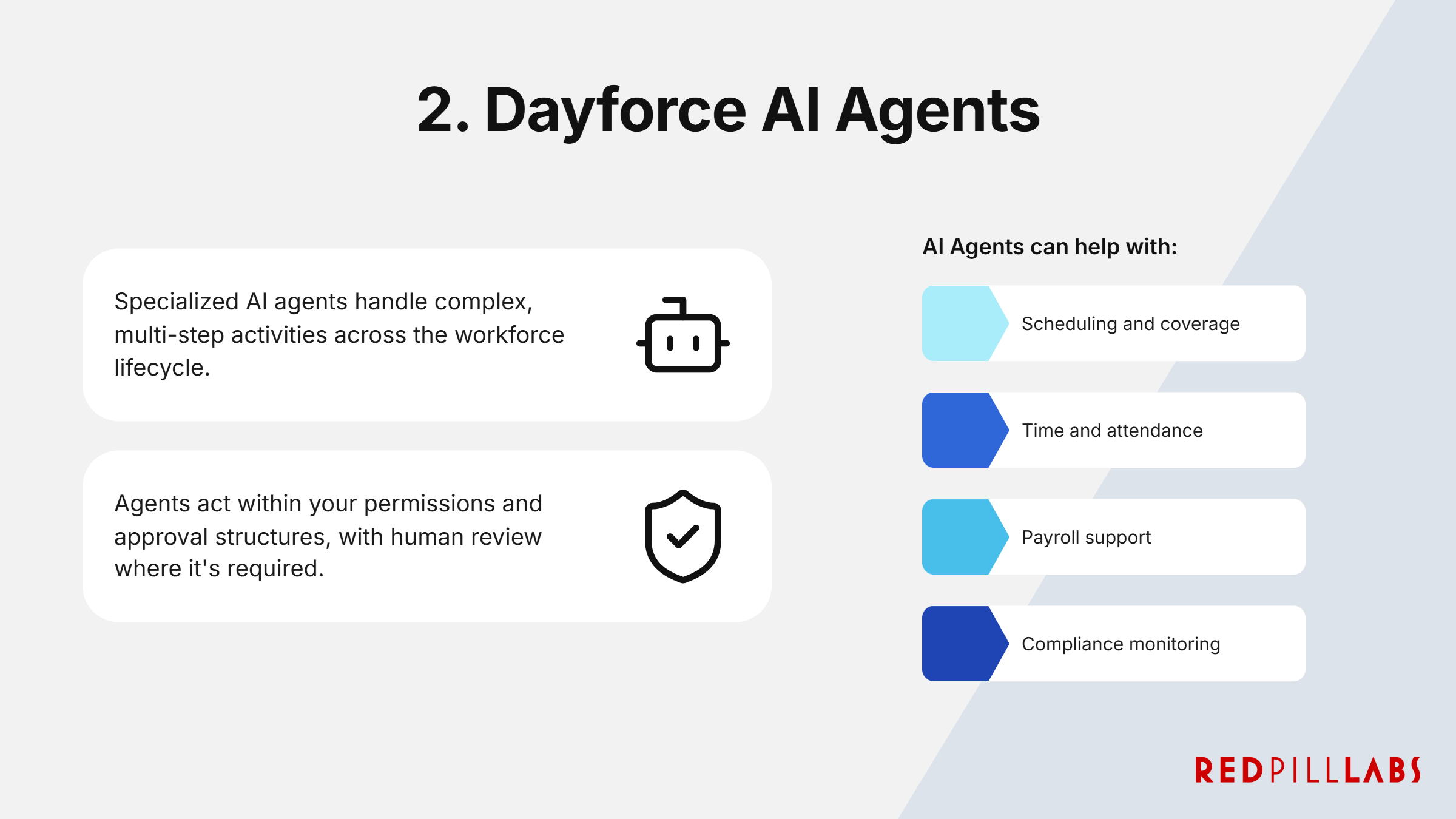
Dayforce AI Agents are specialized AI capabilities designed to handle more complex, multi-step activities across the workforce lifecycle.
While Ask Dayforce provides a conversational entry point, AI Agents are focused on applying specialized intelligence to specific business processes.
They can interpret workforce context, reason through tasks, identify exceptions, and take appropriate action within the permissions and approval structures established by an organization.
Dayforce plans to expand this portfolio with hundreds of agentic tools, skills, and capabilities across the workforce lifecycle.
Potential use cases include:
Scheduling and coverage: Identify staffing shortages and recommend qualified employees based on availability, scheduling rules, and required qualifications.
Time and attendance: Identify missed clock-ins, missed clock-outs, incomplete timesheets, and outstanding approvals before payroll deadlines.
Payroll support: Help investigate payroll inquiries and identify potential issues involving tax calculations, configured rates, wage limits, and overrides.
Compliance monitoring: Monitor regulatory changes, identify potentially affected employees, and guide teams through relevant configuration steps.
Workforce administration: Identify outstanding tasks, exceptions, and administrative activities that require attention.
One particularly useful application is the connection between time management and payroll.
For example, an agent could identify employees with missing time entries before a payroll run, surface the affected records, and guide managers through the necessary corrections and approvals. This can help reduce last-minute payroll adjustments and improve the overall efficiency of payroll operations.
Importantly, these agents are designed to operate within established business rules and permissions. Actions requiring human oversight remain subject to the appropriate review and approval processes.
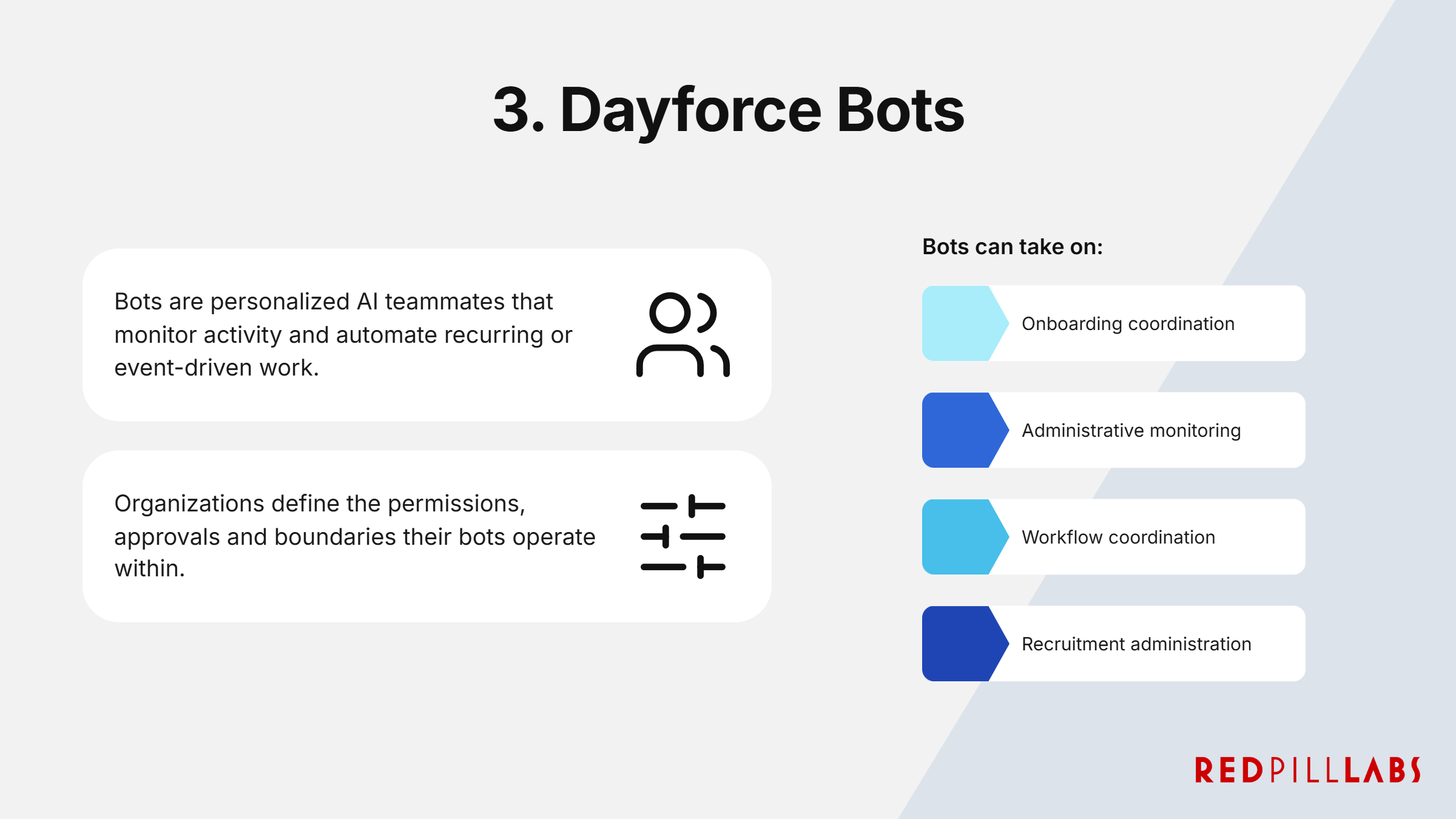
3. Dayforce Bots: Personalized AI Teammates
While Dayforce AI Agents provide specialized capabilities across HCM processes, Dayforce Bots allow organizations to create personalized AI teammates for their own operational requirements.
Through Dayforce Build, customers will be able to configure bots that monitor ongoing activities and automate recurring or event-driven work across Dayforce and connected systems.
Unlike a traditional automation that follows a fixed sequence of instructions, these bots are designed to reason through multi-step assignments and respond to changing circumstances.
Organizations can define the permissions, approvals, and boundaries within which their bots operate.
Potential use cases include:
Onboarding coordination: Monitor onboarding progress and identify outstanding tasks, documentation, or approvals.
Administrative monitoring: Track recurring HR activities and notify relevant teams when something requires attention.
Workflow coordination: Monitor events across connected systems and initiate appropriate next steps.
Recruitment administration: Help coordinate activities across the hiring process, including scheduling and candidate communication.
Recurring reporting: Monitor specified business activities and help generate or distribute relevant reports.
For example, an organization could create a bot to monitor employee onboarding. When a new employee is added to the system, the bot could monitor outstanding onboarding requirements, identify incomplete activities, and notify the appropriate stakeholders.
This provides organizations with an opportunity to automate processes that might otherwise require employees to continuously monitor systems and manually coordinate tasks.
4. Dayforce Build: Create Custom Applications Without Coding
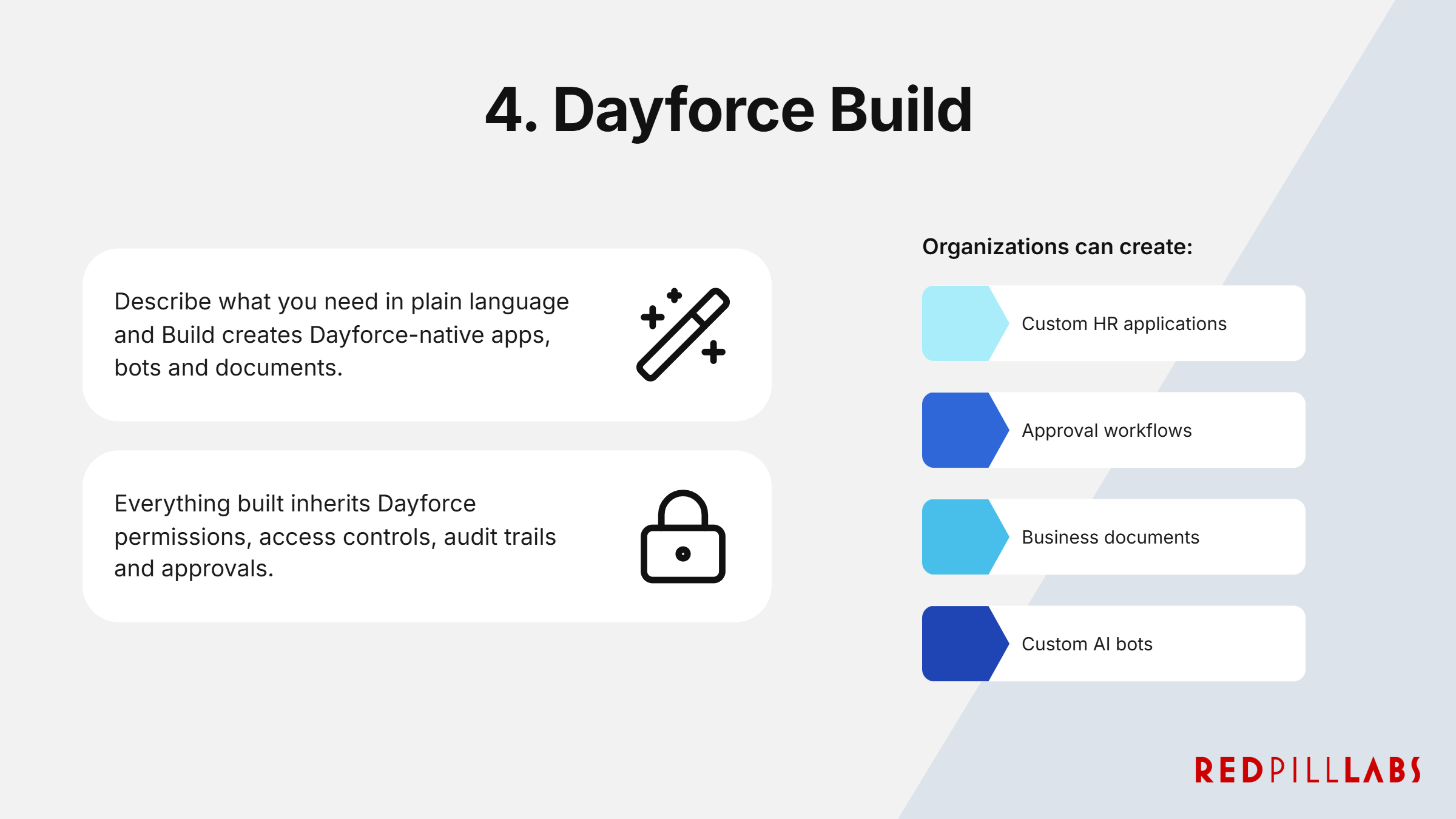
One of the more significant announcements is Dayforce Build, a conversational development experience that allows organizations to create their own Dayforce-native applications, bots, and documents using plain language.
Traditionally, organizations with unique HR or operational requirements have often needed to rely on external applications, additional integrations, or custom development projects.
Dayforce Build is designed to make this process more accessible.
Users can describe what they want to create, and the platform can generate a solution tailored to their business requirements without requiring traditional coding or extensive customization.
Potential use cases include:
Custom HR applications: Create applications that support internal HR processes or address unique workforce requirements.
Approval workflows: Develop tools to coordinate requests, approvals, and administrative activities.
Business documents: Generate presentations, reports, and other business-ready documents using organizational templates and standards.
Operational tools: Build applications that support specific departmental workflows or recurring business activities.
Custom AI bots: Create personalized bots that monitor processes and automate tasks across Dayforce and connected systems.
For example, a business could create a customized internal application to manage a specific employee request process that does not fit neatly into its existing workflows.
Rather than commissioning a separate software development project, authorized users could describe the requirements and use Dayforce Build to create a solution within the existing HCM environment.
Importantly, applications created through Dayforce Build are designed to inherit Dayforce's permissions, access controls, audit trails, and approval workflows.
5. Dayforce Marketplace: An Ecosystem of Applications and Bots
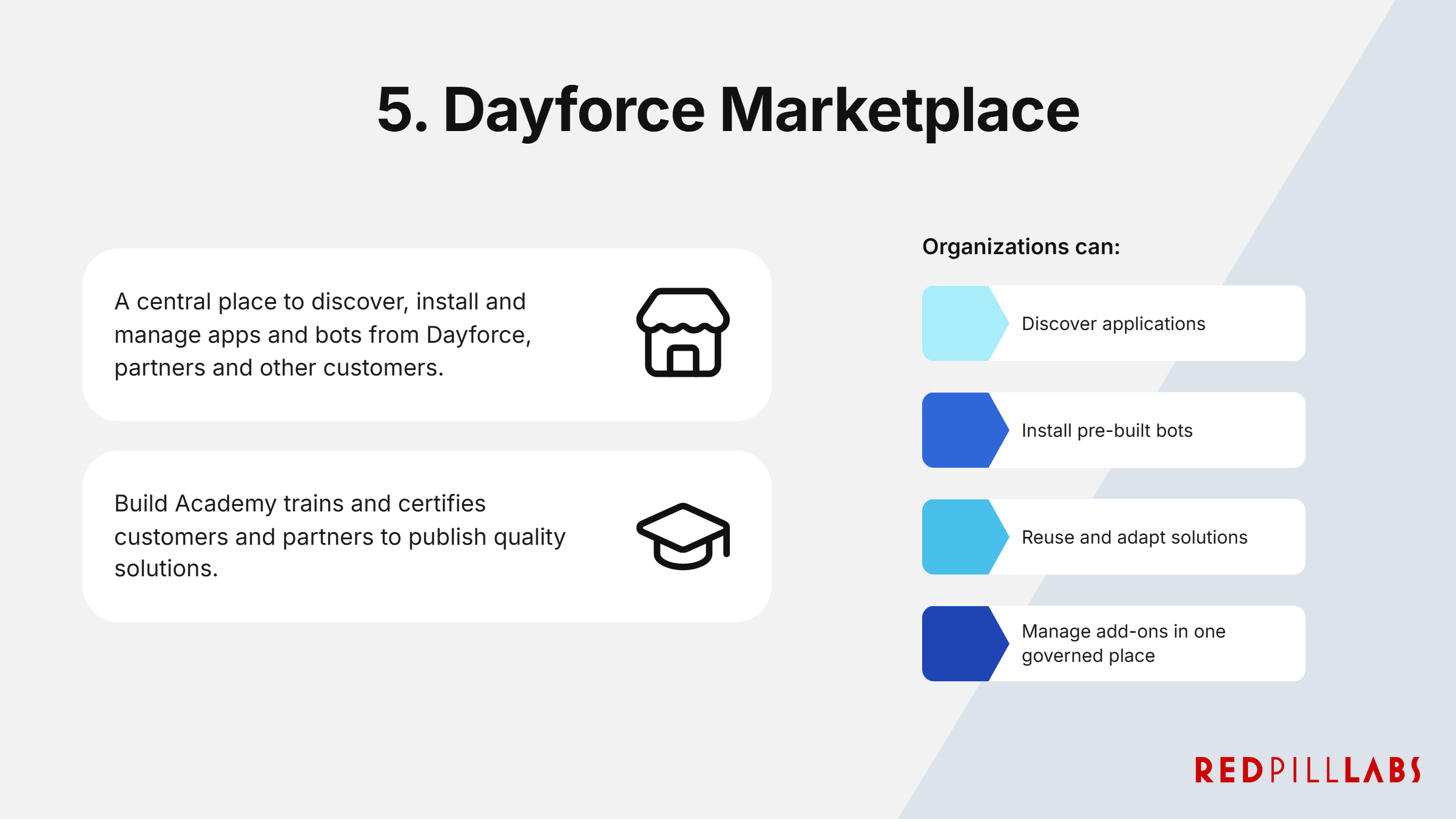
Complementing Dayforce Build is the introduction of Dayforce Marketplace, a centralized ecosystem where organizations can discover, install, and manage pre-built applications, bots, and other solutions.
The Marketplace is intended to include solutions developed by Dayforce, its partners, and other customers.
This creates opportunities for organizations to benefit from solutions that have already been developed for common business requirements rather than building everything internally.
What does this mean for organizations?
Discover applications that address common HR and operational challenges.
Install pre-built bots to support recurring activities.
Access solutions developed by Dayforce and its partner ecosystem.
Reuse and adapt applications created by other organizations.
Manage additional capabilities within a more connected and governed environment.
Dayforce also introduced Build Academy, a training and certification program intended to help customers and partners develop the skills required to publish quality solutions to the Marketplace.
Over time, this ecosystem could help organizations address more specialized business requirements while reducing their reliance on disconnected third-party applications.
6. A More Connected Dayforce: AI Interoperability
Another important part of the Agentic HCM strategy is interoperability.
Organizations increasingly use multiple AI tools, business applications, and enterprise systems. Rather than requiring employees to work exclusively within one platform, Dayforce is expanding the ways its data and capabilities can connect with external technologies.
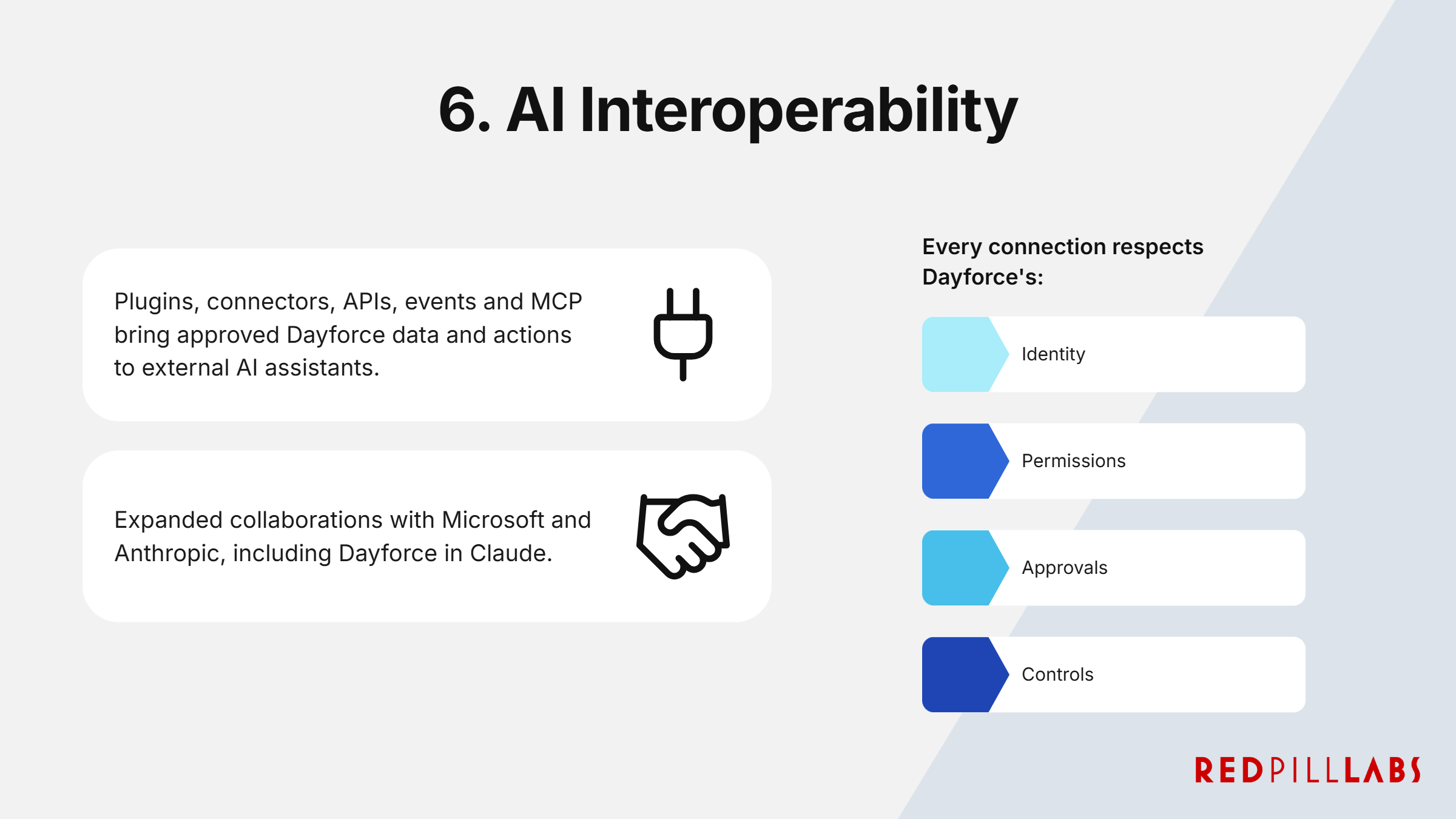
Through plugins, connectors, APIs, events, and the Model Context Protocol (MCP), Dayforce aims to make approved workforce information and actions accessible through external AI assistants and business systems.
Dayforce also announced expanded collaborations with Microsoft and Anthropic, including Dayforce integration with Claude.
Potential use cases include:
Accessing relevant Dayforce workforce information through approved external AI assistants.
Initiating supported Dayforce actions without navigating directly into the platform.
Connecting workforce information with broader business processes.
Enabling employees to interact with HCM information through familiar workplace tools.
Reducing the need to switch between applications to complete administrative tasks.
For example, an employee could interact with an approved external AI assistant to ask a question about their Dayforce information or initiate a supported request without having to navigate through the entire HCM interface.
The important distinction is that interoperability does not mean unrestricted access to employee information. Connections are designed to respect the identity, permissions, approvals, and controls established within Dayforce.
Agentic AI Across the Dayforce Platform: Features and Business Use Cases
Beyond its core agentic building blocks, Dayforce announced a series of enhancements across its existing HCM capabilities.
These developments extend the application of AI into specific business functions, connecting workforce intelligence with the operational processes organizations manage every day.
7. Recruiting and Talent Acquisition
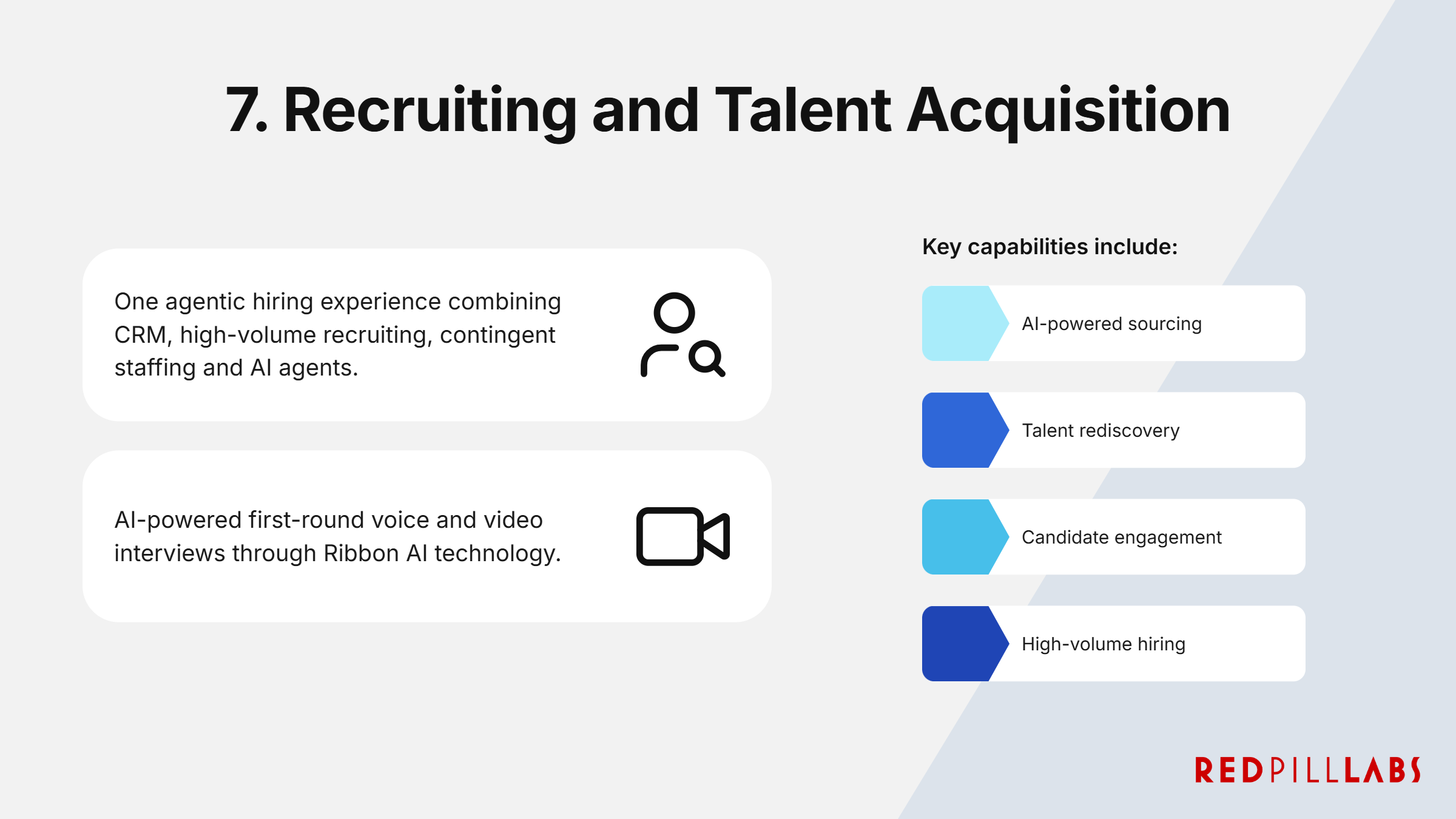
Dayforce is introducing a reimagined, agentic recruiting experience designed to support the entire hiring lifecycle.
The new experience brings together candidate relationship management (CRM), high-volume recruitment workflows, contingent staffing coordination, and AI agents.
The objective is to reduce administrative work throughout recruitment while helping organizations identify, engage, and hire qualified candidates more efficiently.
Key capabilities include:
AI-powered sourcing: Help recruiters identify potential candidates based on organizational hiring requirements.
Talent rediscovery: Revisit existing candidate pools to identify individuals who may be suitable for current vacancies.
Candidate engagement: Support communication and interactions throughout the recruitment process.
Voice and video interviews: Introduce conversational AI-powered first-round interview capabilities through Ribbon AI technology.
Candidate insights: Provide additional information to support candidate evaluation and recruitment decisions.
High-volume hiring: Coordinate recruitment workflows for organizations managing large numbers of applicants.
Staffing partner coordination: Connect organizations with external staffing partners through more integrated hiring workflows.
An example would be a retail organization recruiting hundreds of seasonal employees across multiple locations. AI-powered sourcing, candidate rediscovery, and automated interview processes could help recruiters manage higher application volumes while focusing their attention on qualified candidates and hiring decisions.
Dayforce also announced an agreement to acquire Ribbon AI. Following the anticipated completion of the transaction, Ribbon's technology is expected to be integrated into the new Dayforce Talent experience.
8. Learning and Performance Management
Dayforce is also expanding its use of AI across employee development and performance management.
The objective is to help organizations identify existing workforce capabilities, recognize skills gaps, and connect employees with relevant development opportunities.
Learning
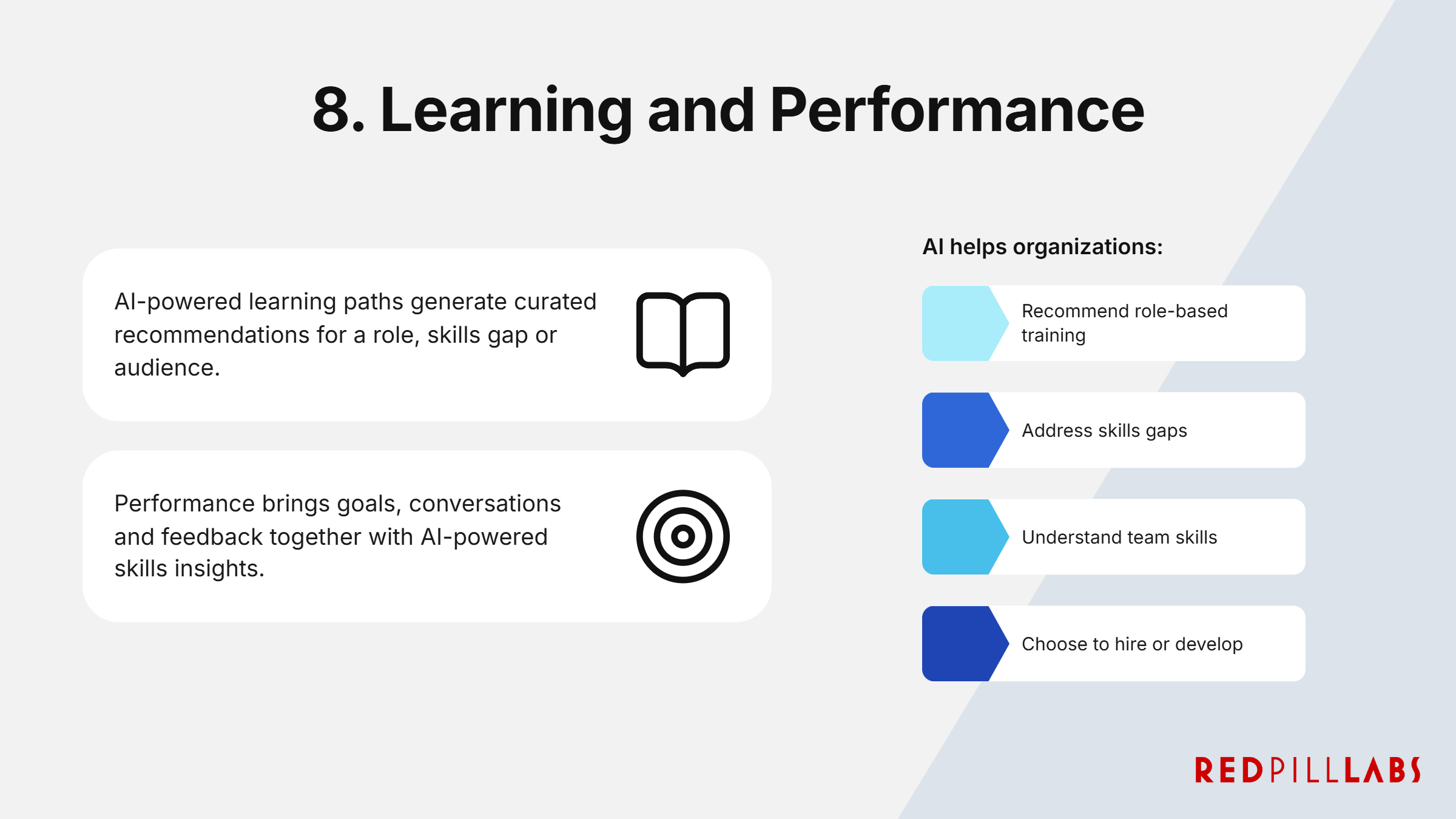
New AI-powered learning paths will allow organizations to describe a specific role, skills gap, or employee audience and generate curated learning recommendations.
Conversational learning agents will also help employees and managers identify relevant training and take action within existing permissions.
Potential applications include:
Recommending training based on an employee's role or development needs.
Identifying learning opportunities to address organizational skills gaps.
Helping employees locate relevant development resources.
Supporting managers in coordinating employee development.
Performance Management
Dayforce is introducing enhanced performance management experiences that bring together employee goals, ongoing conversations, and feedback.
AI-powered insights will help managers better understand the skills available within their teams, identify development opportunities, and assess where additional capabilities may be required.
For example, an organization planning to expand its technology department could use workforce skills insights to determine whether it should recruit externally or invest in developing existing employees.
This creates a more connected approach to talent management, linking performance, learning, and recruitment decisions.
9. Workforce Management: Scheduling, Time and Payroll
One of the most operationally significant areas of the announcement is the connection between workforce management and payroll.
Dayforce introduced several enhancements designed to simplify how organizations manage employees from scheduling through to pay.
These capabilities are particularly relevant for businesses with hourly employees, multiple locations, complex scheduling requirements, and large frontline workforces.
Dayforce Command Center for Frontline Operations
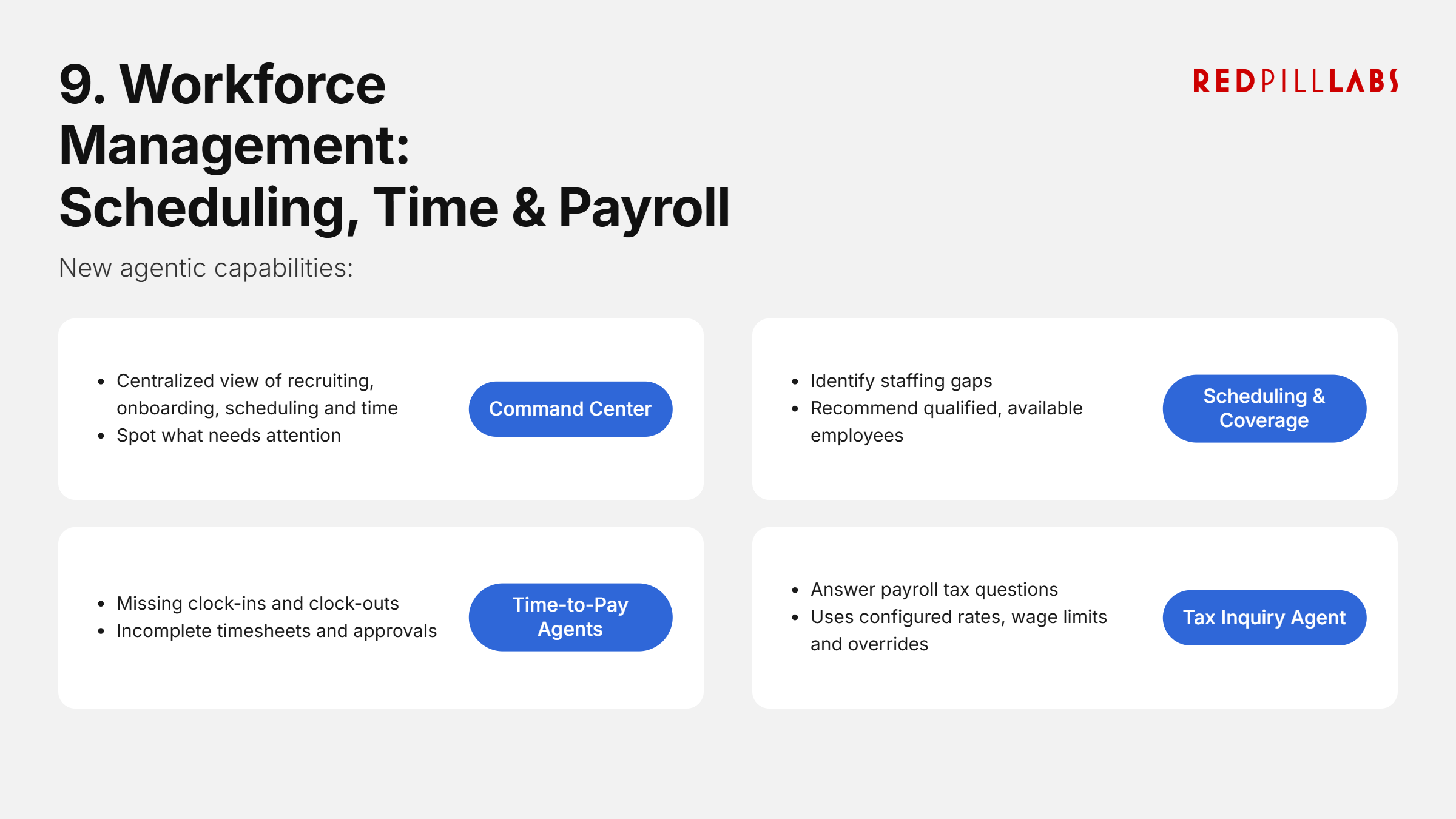
The new Command Center provides managers with a centralized view of operational activities across recruiting, onboarding, scheduling, and time management.
Rather than reviewing multiple areas of the system independently, managers can use a more connected experience to identify issues and determine what requires attention.
Scheduling and Coverage Agents
AI-powered scheduling capabilities are designed to identify staffing gaps and recommend employees who meet the relevant qualifications, availability, and scheduling requirements.
Managers can review and approve recommendations rather than manually searching through employee schedules.
Time-to-Pay Agents
These agents are designed to identify issues that could affect payroll processing, including:
Missing clock-ins and clock-outs.
Incomplete timesheets.
Outstanding manager approvals.
Timekeeping exceptions.
Issues requiring resolution before payroll deadlines.
Tax Inquiry Agent
The tax inquiry agent is designed to help answer questions about payroll tax calculations using configured tax rates, wage limits, and overrides within Dayforce.
For organizations managing complex payroll environments, these capabilities could help reduce the administrative burden associated with investigating payroll inquiries and resolving exceptions.
10. Contingent Workforce Management
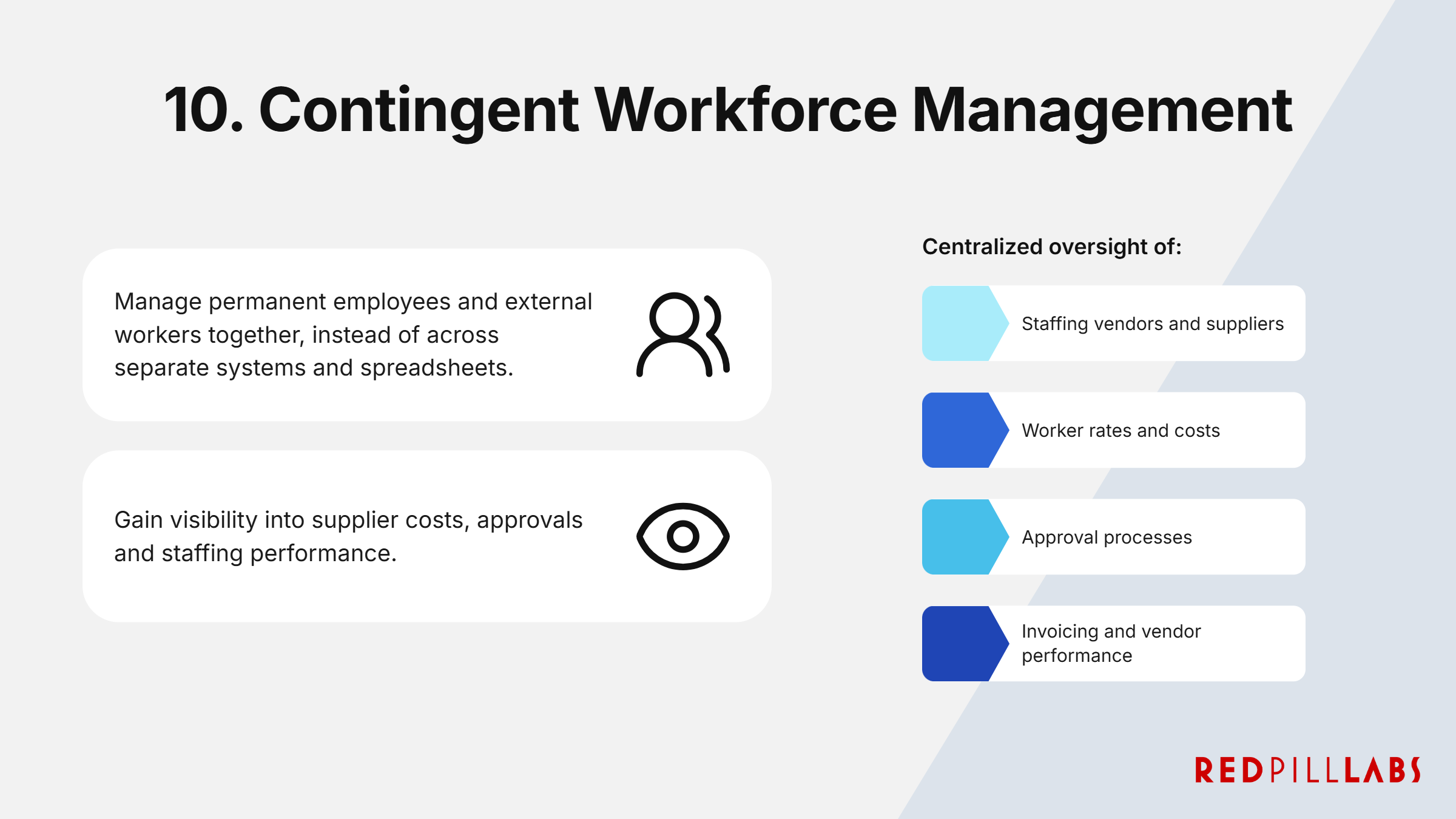
Another notable development is Dayforce Contingent Workforce Management, which expands the platform's ability to support organizations managing a combination of permanent employees and external workers.
Many organizations rely on staffing agencies, contractors, and other contingent labour arrangements to meet changing operational demands. However, managing these relationships often involves separate systems, spreadsheets, and administrative processes.
The new capabilities are designed to centralize oversight of:
Staffing vendors and supplier relationships.
Contingent labour requirements.
Worker rates and associated costs.
Approval processes.
Supplier invoicing.
Vendor performance.
For example, an organization using multiple staffing agencies to support its warehouse operations could gain greater visibility into its contingent workforce, including supplier costs, approvals, and staffing performance.
This can help organizations better coordinate their total workforce while improving oversight of external labour arrangements.
11. Strategic Workforce Planning: Planning for People and AI Agents
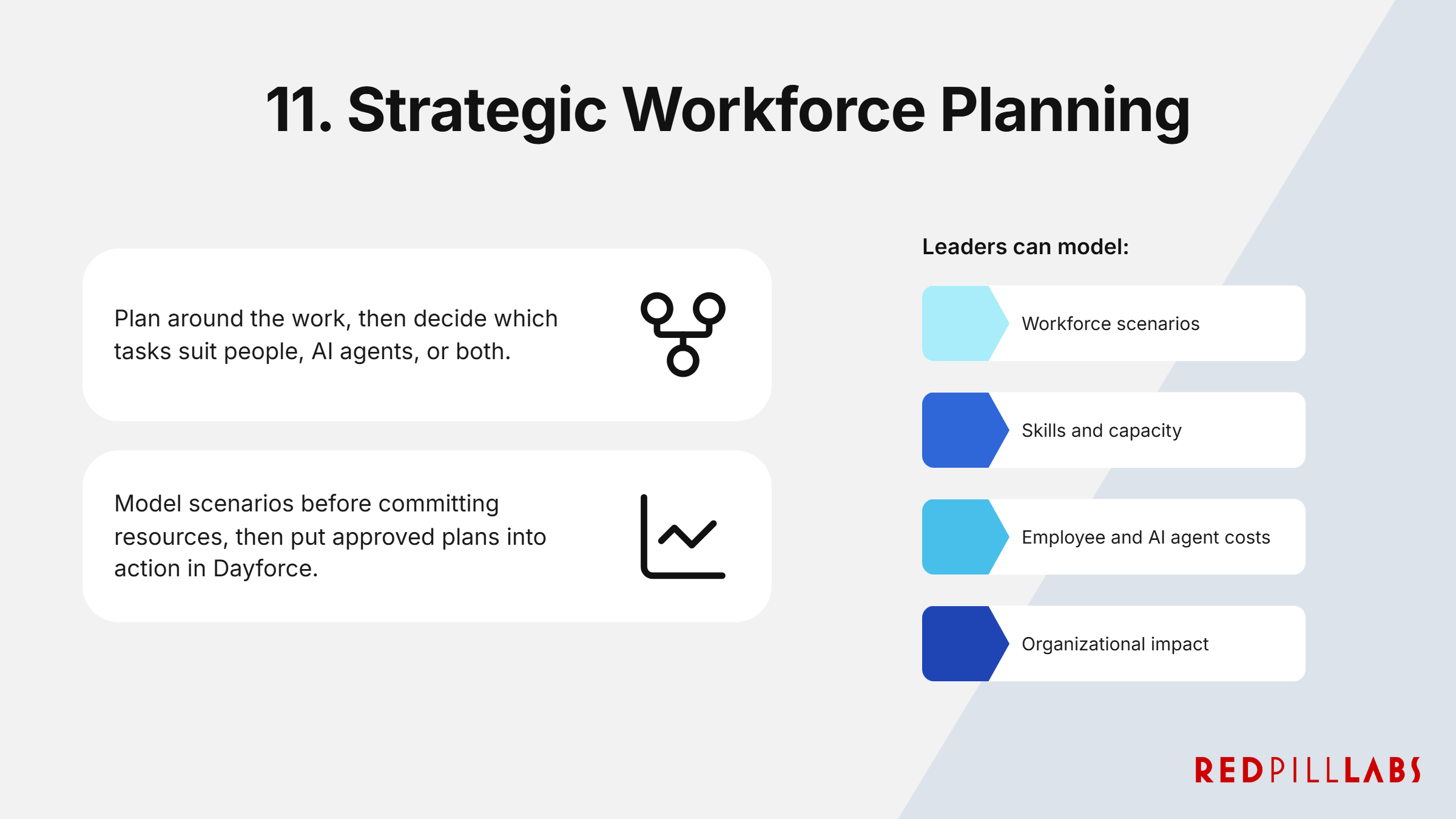
Perhaps one of the more forward-looking capabilities announced is the Dayforce Strategic Workforce Planning Agent.
Traditional workforce planning often begins with headcount, focusing on how many employees an organization needs, where they are needed, and how much they will cost.
Dayforce is introducing a different approach: planning around the work that needs to be completed and determining which responsibilities should be performed by people, AI agents, or a combination of both.
The Strategic Workforce Planning Agent uses organizational workforce data, skills, structures, and costs to help leaders model different workforce scenarios.
Key capabilities include:
Workforce scenario modelling: Explore different organizational structures and staffing scenarios.
Skills analysis: Assess the skills an organization currently has compared with the skills required for future operations.
Capacity planning: Evaluate whether the existing workforce has the capacity to meet operational requirements.
Cost modelling: Assess the financial implications of potential workforce changes, including both employee and AI agent costs.
People and AI planning: Evaluate which activities should be performed by employees, AI agents, or a combination of the two.
Organizational impact: Understand the potential downstream effects of workforce changes before implementing them.
For example, a business considering a major operational expansion could model different scenarios to determine whether it should hire additional employees, restructure existing teams, introduce AI agents to support certain activities, or combine these approaches.
The agent is designed to help leaders assess the potential impact of these decisions before committing resources.
An important distinction is that workforce planning and execution are connected through the Dayforce platform. This creates a path from modelling potential changes to putting approved workforce plans into action.
12. HR Administration: Forms, Benefits and Policy Management
Dayforce is also introducing enhancements to everyday HR administration.
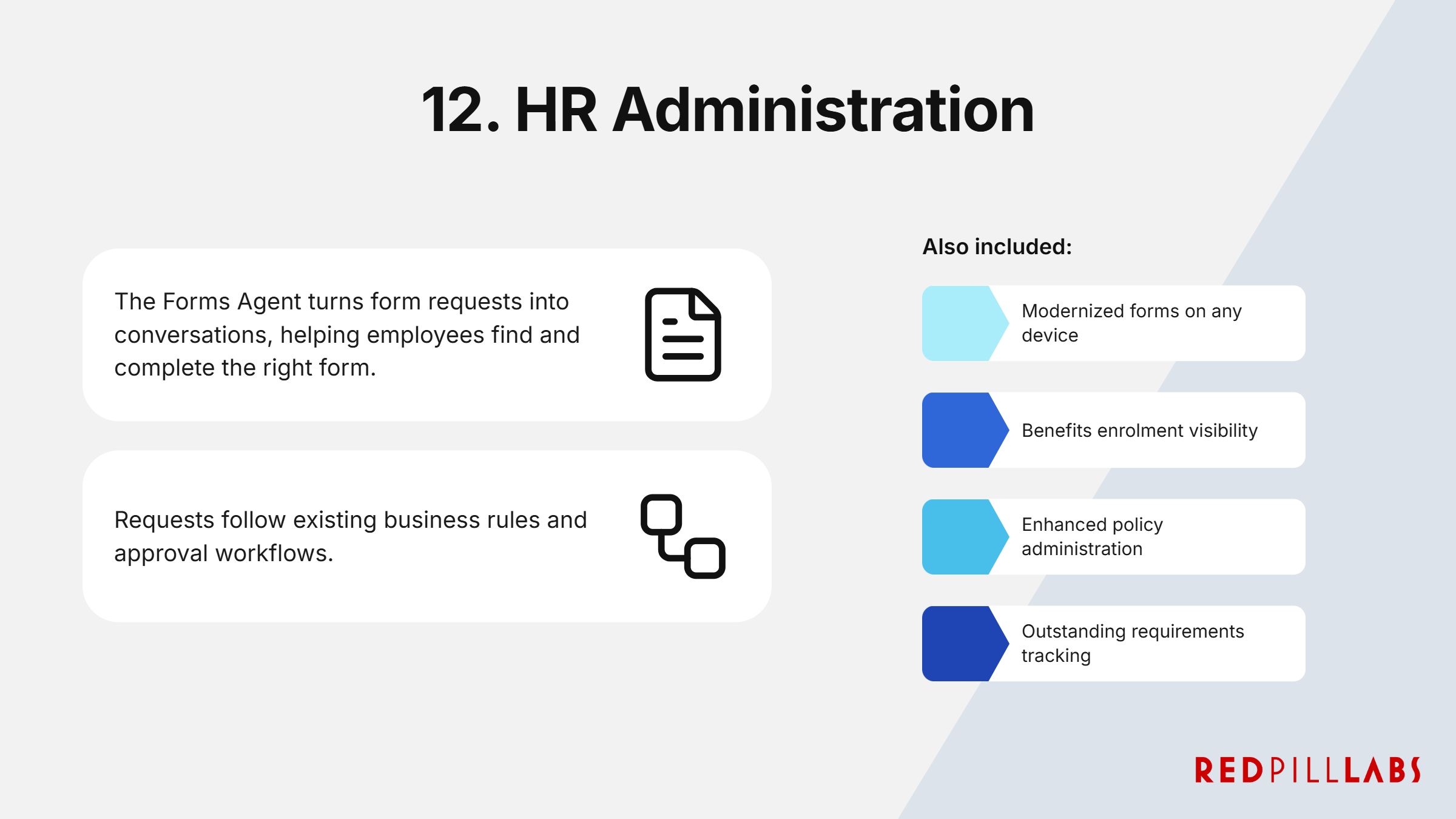
One example is the new Forms Agent, which turns traditional form-related requests into conversational interactions.
Rather than requiring employees to locate the correct form, understand which information is required, and navigate the submission process independently, the agent is designed to help employees identify and complete the appropriate forms.
It follows existing business rules and approval workflows, helping ensure requests are routed through the appropriate processes.
Additional enhancements include:
A modernized forms experience across devices.
Continued support for existing XML forms.
Improved visibility into benefits enrolment progress.
Enhanced policy administration.
Better visibility into outstanding employee requirements and follow-up activities.
For HR teams, this could help reduce the administrative effort associated with answering routine questions, processing employee requests, and monitoring outstanding documentation.
Dayforce Deploy: Bringing Agentic AI Into HCM Implementation
Beyond the day-to-day management of employees, Dayforce is applying agentic AI to another important area of the HCM lifecycle: implementation.
Dayforce Deploy is a new AI-powered implementation approach designed to connect requirements gathering, system configuration, and testing within an intelligent implementation workspace.
Traditionally, HCM implementations require significant coordination between business stakeholders, implementation consultants, technical teams, and project managers.
Requirements are gathered through workshops and documentation, translated into system configurations, and repeatedly tested to ensure the solution supports the organization's business processes.
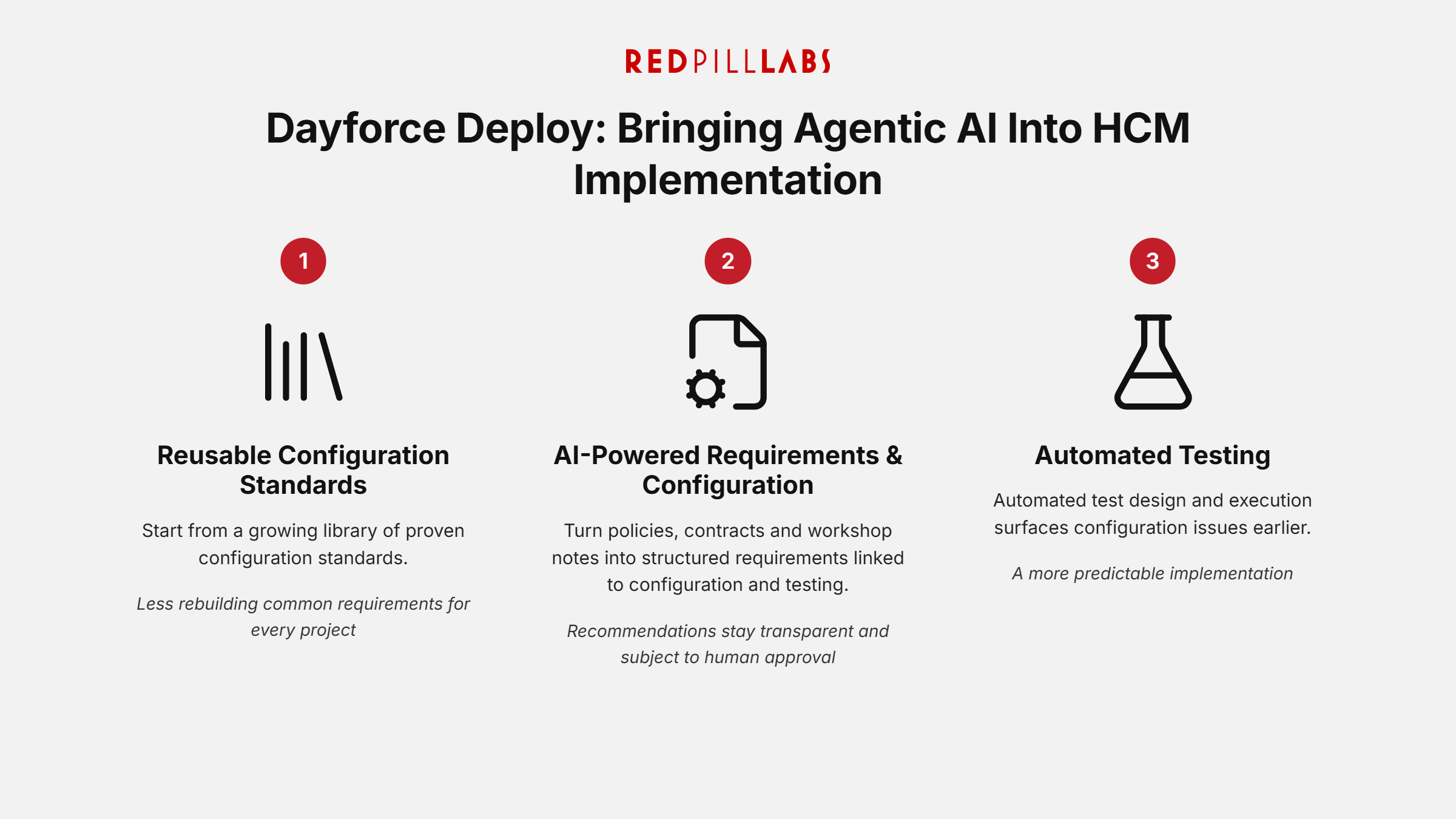
Dayforce Deploy is designed to streamline this work through three primary capabilities:
1. Reusable Configuration Standards
Implementation teams can leverage a growing library of proven configuration standards rather than rebuilding common requirements from scratch for every project.
2. AI-Powered Requirements and Configuration
Dayforce Deploy can use information from customer policies, contracts, and workshop notes to generate structured requirements and organize implementation activities.
It then connects those requirements to configuration and testing activities, with recommendations remaining transparent and subject to human review and approval.
3. Automated Testing
The platform is designed to support automated test design and execution, helping implementation teams identify configuration issues and potential problems earlier in the project lifecycle.
For organizations, the potential benefits include less repetitive manual work, improved visibility between requirements and configurations, and a more predictable implementation process.
This is particularly significant because the value of an HCM platform depends not only on its capabilities but also on how effectively it is implemented and configured to support an organization's processes.
Security, Governance and Human Oversight
As AI moves from generating information to taking action, security and governance become increasingly important.
HCM systems contain some of an organization's most sensitive information, including employee records, compensation, payroll details, benefits, and personal information.
Allowing AI to interact with these processes requires more than simply providing access to data.
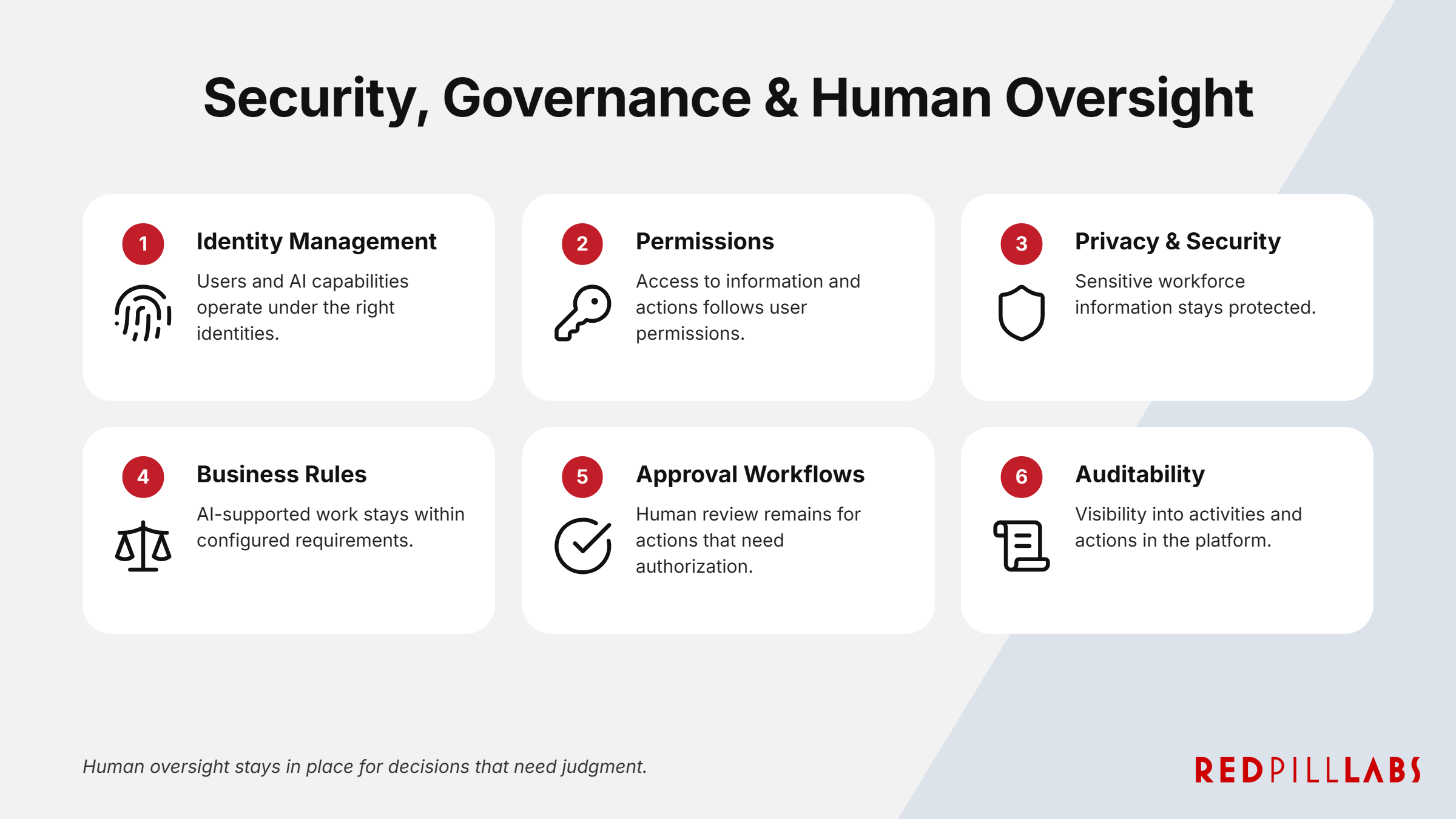
Dayforce's Agentic HCM Platform is designed around a governance foundation that incorporates:
Identity management: Ensuring users and AI capabilities operate under the appropriate identities.
Permissions: Restricting access to information and actions based on established user permissions.
Privacy and security: Protecting sensitive workforce information.
Business rules: Ensuring AI-supported activities operate within configured organizational requirements.
Approval workflows: Maintaining appropriate human review for actions that require authorization.
Auditability: Supporting visibility into activities and actions performed within the platform.
These controls are particularly important in areas such as payroll, employee scheduling, benefits administration, and compliance management, where incorrect actions can have direct financial or operational consequences.
The objective is not to remove human oversight from workforce management. Rather, it is to reduce repetitive work while allowing employees and managers to retain accountability for decisions that require their judgment.
What Does Dayforce Agentic HCM Mean for Organizations?
The introduction of Agentic HCM represents a broader shift in how organizations may interact with their HCM systems.
Historically, HR and payroll platforms have primarily served as systems for recording information, managing transactions, and supporting administrative workflows.
AI introduces an opportunity to build on that foundation by helping organizations interpret information, identify issues, and move processes forward.
For organizations, the potential benefits span several areas:
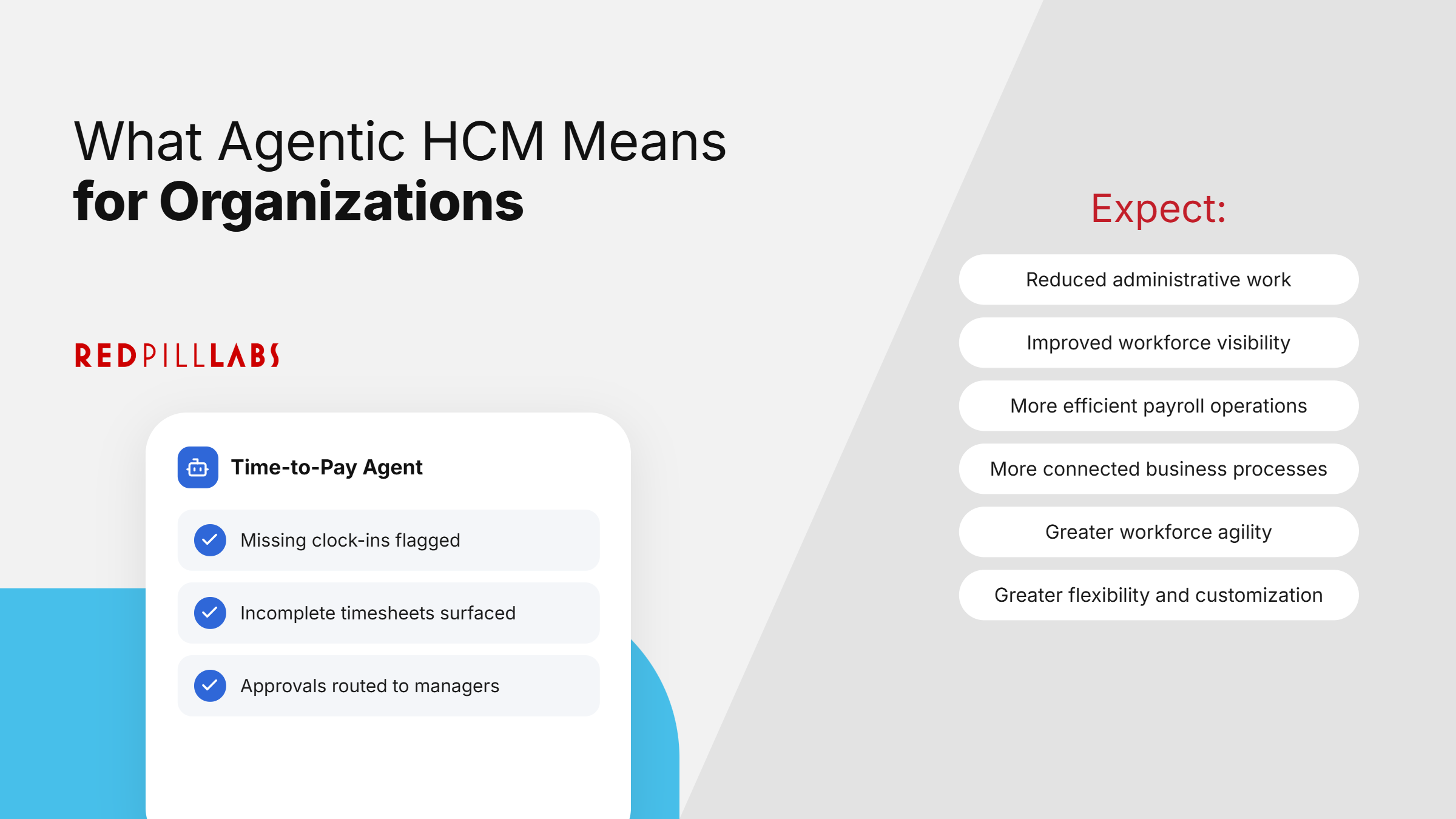
Reduced Administrative Work
AI agents and bots can help manage recurring activities, identify outstanding tasks, and reduce the amount of manual coordination required across HR and payroll teams.
Improved Workforce Visibility
Conversational AI and specialized agents can make workforce information more accessible, helping managers and HR professionals identify trends and exceptions without relying exclusively on manual reporting.
More Efficient Payroll Operations
By identifying missing time entries, incomplete timesheets, and outstanding approvals before payroll deadlines, AI can help payroll teams address issues earlier in the pay cycle.
More Connected Business Processes
The integration of HR, payroll, scheduling, talent, and workforce planning capabilities creates opportunities to reduce administrative gaps between departments and business functions.
Greater Workforce Agility
AI-powered skills analysis and workforce planning can help organizations make more informed decisions about hiring, employee development, restructuring, and the use of AI within their operations.
Greater Flexibility and Customization
Dayforce Build and Marketplace introduce opportunities for organizations to address specialized requirements without necessarily relying on separate applications or extensive custom development.
Ultimately, the opportunity is to move away from simply managing workforce information toward using that information to make better decisions and complete work more efficiently.
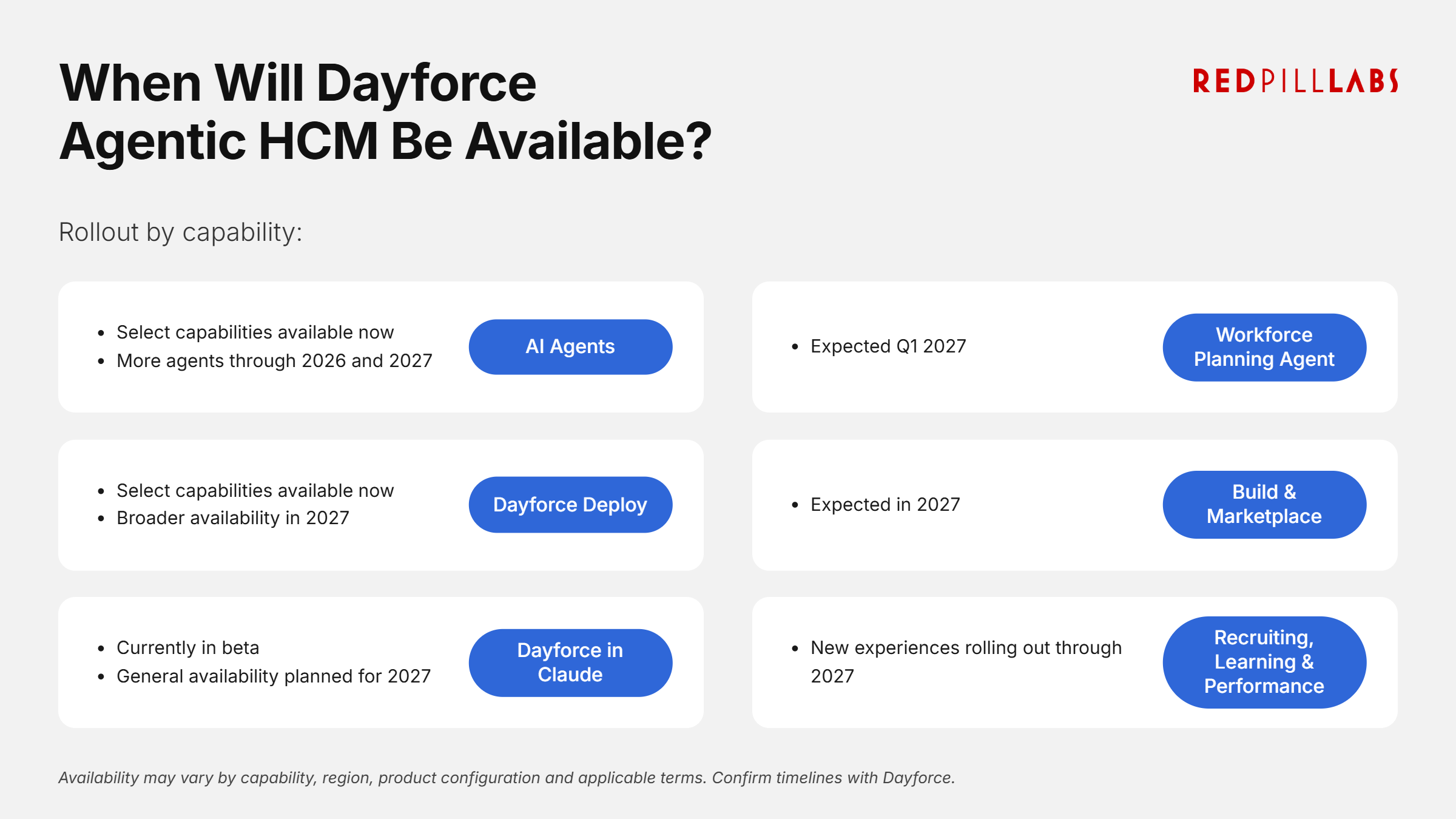
When Will Dayforce Agentic HCM Be Available?
Although Dayforce unveiled the Agentic HCM Platform on October 27, 2026, not every capability announced is immediately available.
The rollout is expected to take place in stages throughout 2026 and 2027.
As outlined in Dayforce's announcements:
Dayforce AI Agents: Select capabilities are available now, with additional agents and experiences planned throughout 2026 and 2027.
Dayforce Deploy: Select capabilities are available now, with broader general availability planned for 2027.
Dayforce Build and Marketplace: Expected to become available in 2027.
Dayforce in Claude: Currently in beta, with general availability planned for 2027.
Strategic Workforce Planning Agent: Expected to become available in Q1 2027.
Agentic Recruiting, Learning and Performance: New experiences are planned to roll out throughout 2027.
Additional workforce management and payroll agents: Further capabilities are expected at different times throughout 2026 and 2027.
Availability may vary by capability, region, product configuration, and applicable terms. Organizations should confirm specific functionality and rollout timelines with Dayforce.